Trail Running vs Hiking in California: How to Choose (and Why Your Shoes Matter More Than You Think)
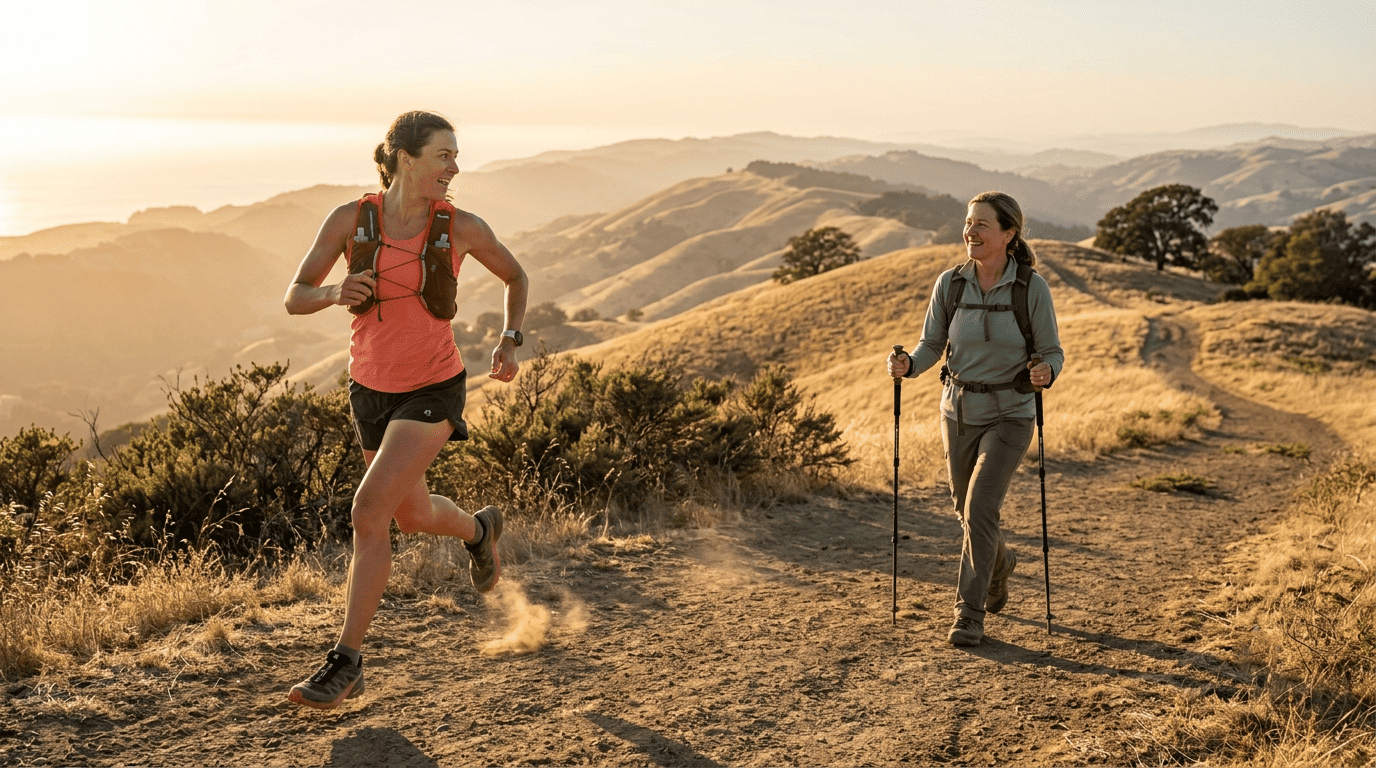
While Trail running vs hiking might seem like a simple choice between two sports that share the same paths, they are fundamentally different activities with distinct paces. Trail running is a cardio-first, time-efficient way to cover ground; hiking is a slower, more sustainable way to be out there longer. The real dividing line isn’t fitness level; it’s what you want out of the same mile of dirt.
Disclosure: Please note that some of the links below are affiliate links and at no additional cost to you, I may earn a commission. Know that I only recommend hiking gear I personally stand behind; when you use my affiliate links, it helps me run this blog and keep all of this content free of charge for readers (like you).
Key takeaways
- Speed is the core difference: trail running sits around a 6–12 min/mile pace in a higher heart-rate zone, hiking runs 2–4 mph in a lower one.
- The shoe question has a real answer: trail runners work fine for day hikes with a light pack; hiking boots win once you’re carrying 30+ lbs or crossing technical, wet terrain.
- Trail running burns more per hour (roughly 600–900 cal/hour vs 400–550 for hiking at the same body weight and terrain), but hiking’s lower impact makes it more sustainable over a full day.
- Injury patterns differ by activity: trail running skews toward IT band syndrome and stress fractures, hiking skews toward descent-related knee pain and blisters.
- Some California trails are built for one or the other. Cactus to Clouds rewards runners’ fitness, while the John Muir Trail rewards a hiker’s patience.
What is the difference between trail running and hiking?
Trail running is running, just on unpaved, uneven ground instead of pavement. You’re moving at a running gait, your heart rate sits higher, and you cover distance fast. Hiking is walking with intention, at a pace that lets you sustain hours or days on trail rather than minutes or a couple of hours. Both use the same trails; they extract different experiences from them. For more details on different kinds of trail surfaces, see our what are hiking trails guide.
Speed, effort, and intensity: how trail running and hiking compare
| Trail running | Hiking | |
|---|---|---|
| Pace | 6–12 min/mile | 2–4 mph |
| Heart rate zone | Zone 3–4 | Zone 2–3 |
| Session length | Usually under 3 hours | Hours to multiple days |
| Primary benefit | Cardio efficiency | Sustainable, low-impact distance |
Neither pace is “better”; they’re built for different goals. If you want a hard hour of cardio, run it. If you want to be out on a mountain all day, hike it.
When the same California trail serves both trail runners and hikers
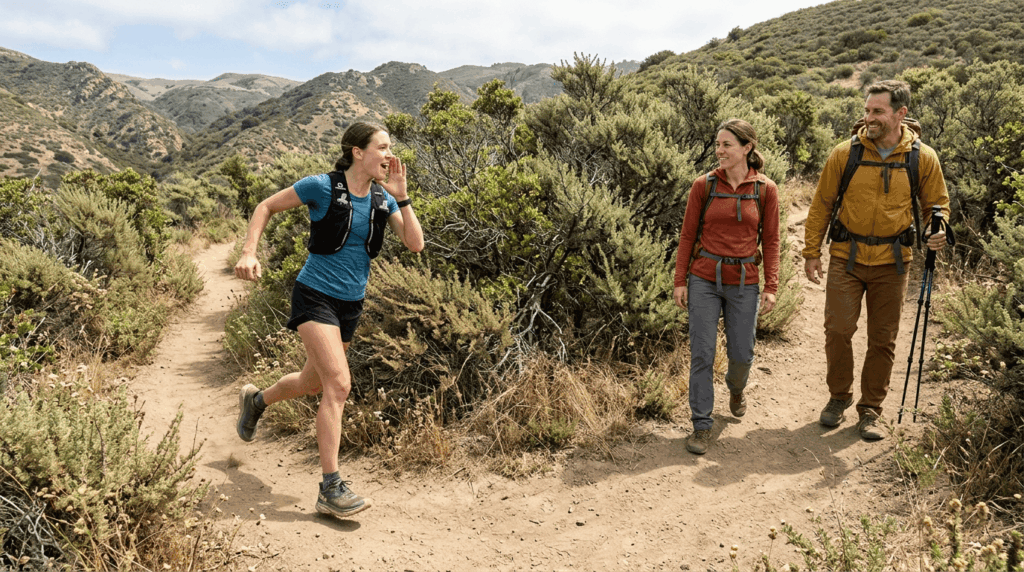
Multi-use trails like the Marin Headlands, Runyon Canyon, and the fire roads on Mount Tamalpais see both crowds constantly, and the etiquette that keeps it working is simple: runners yield to hikers on narrow single-track, and everyone calls out before passing. I’ve had more close calls from silent passes on blind corners than from anything else on a shared trail. A simple “on your left” solves nearly all of it. Read our full hiking trail etiquette guide for sharing multi-use routes.
Trail running shoes vs hiking shoes: the gear difference that defines both activities
This is the question I get asked more than any other, and it deserves a real answer instead of “it depends.”
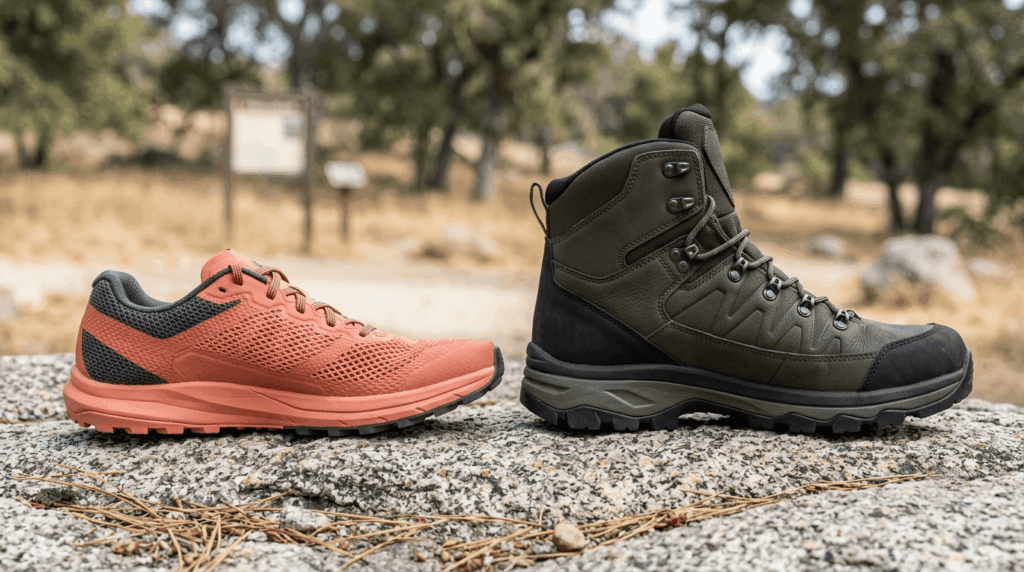
Trail running shoes vs hiking shoes: construction, sole, and weight differences
| Trail running shoe | Hiking shoe/boot | |
|---|---|---|
| Weight | 6–10 oz | 10–16 oz |
| Sole stiffness | Flexible, low stack | Stiffer, more protective |
| Drainage | Fast (mesh upper) | Slower, more water-resistant |
| Ankle support | Minimal | Low to high depending on style |
| Best for | Light pack, faster pace, day trips | Heavy pack, technical terrain, multi-day |
Trail running shoes vs hiking boots: when the boot still wins in California
Boots win the moment your pack crosses 30 lbs, the terrain turns into loose talus or scrambling, or you’ve got a history of ankle injuries that a rigid upper actually protects. On the John Muir Trail with a full multi-day load, I’d take boots or a stiff trail shoe over a minimalist runner every time; the extra support matters more than the weight savings once your pack is doing the loading, not your legs. See our deep-dive comparison in the best hiking shoes guide.
Can you use trail running shoes for hiking in California?
Yes, for the majority of California day hikes, light pack, moderate terrain, dry conditions. The trade-off shows up once you’re carrying real weight or crossing wet, technical ground, where the stiffer sole and better water resistance of a hiking shoe start to matter.
Can you use hiking shoes for trail running in California?
You can, but it’s a compromise: the stiffer sole reduces the ground feedback your feet want at a running pace, and the extra weight slows you down over distance. It’s fine for casual trail jogging; it’s not what you’d choose for a serious training run.
Fitness benefits: trail running vs hiking for cardiovascular health
Both build real fitness, just on different timelines. Trail running delivers faster VO2 max gains because the effort is more intense; hiking builds a broader aerobic base because you can sustain it for so much longer without breaking down.
Calorie burn comparison: trail running vs hiking in California
At the same body weight and terrain, trail running burns roughly 600–900 calories an hour against hiking’s 400–550. That gap narrows fast on steep grades, though a heavily loaded uphill hike can rival a flat trail run for total calorie burn per hour.
Impact and injury risk: which is safer for your joints in California?
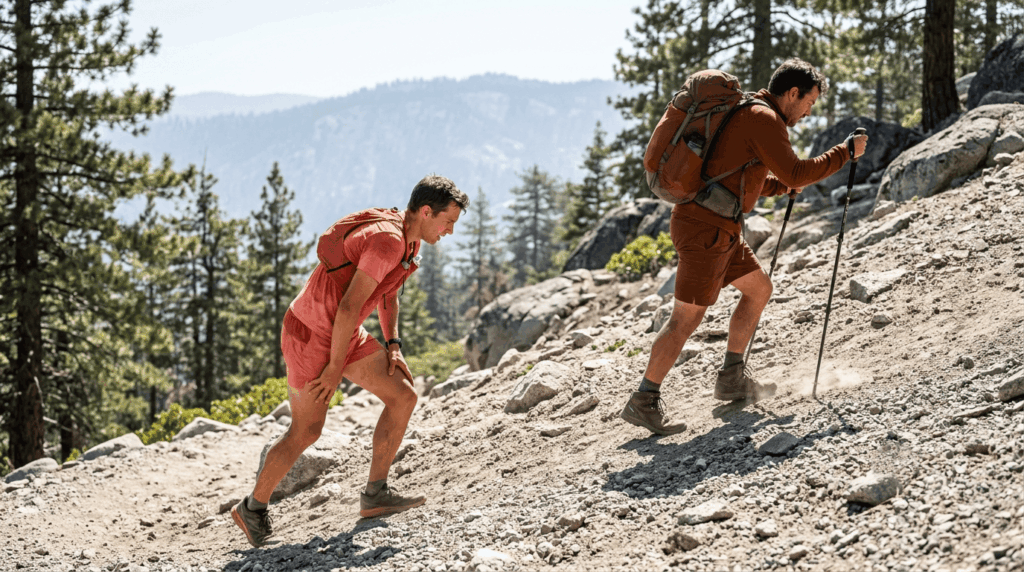
Trail running hits your joints with 3–5 times your body weight in impact force on every step, which is why acute injuries show up faster and more often than in hiking. Hiking’s injury risk is quieter but real; it’s cumulative, showing up as knee strain on long descents rather than a single dramatic moment.
Common trail running injuries vs common hiking injuries in California
Trail runners deal with IT band syndrome, stress fractures, and ankle sprains from pace-driven missteps on uneven footing. Hikers deal with knee pain on descents, blisters from hours in the same shoes, and overuse tendinitis from repetitive motion on long days.
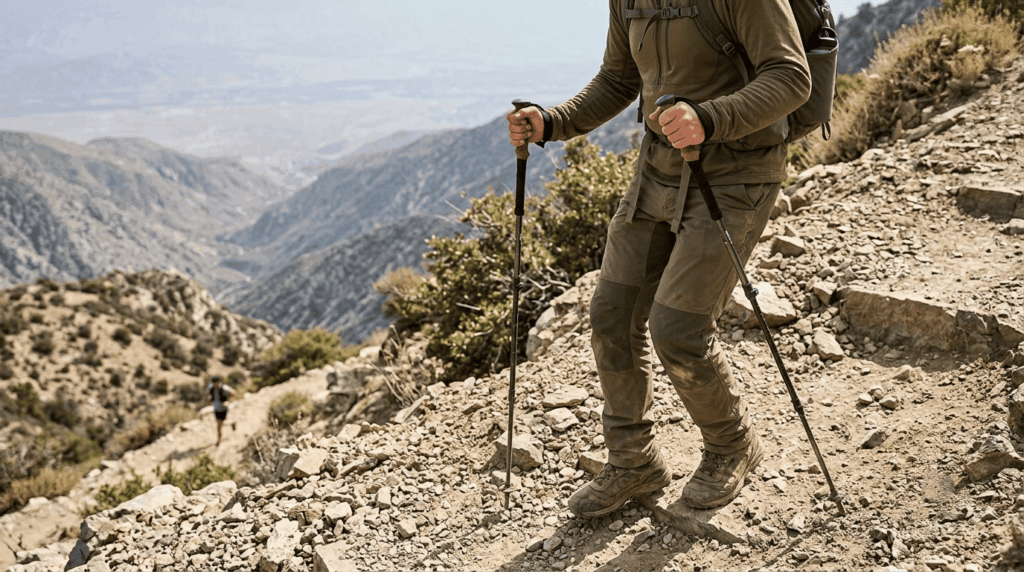
Both are largely preventable: runners do better building mileage gradually and strengthening hips and glutes to control that IT band stress, while hikers do better with trekking poles on steep descents and a shoe fit that’s checked before, not after, a blister forms.
Best trails in California for trail running
Good running trails and good hiking trails aren’t always the same trails; runners want fast, well-drained footing and loop options, while hikers can tolerate slower, rockier ground for a better view.
Best trail running routes in the Bay Area and Northern California
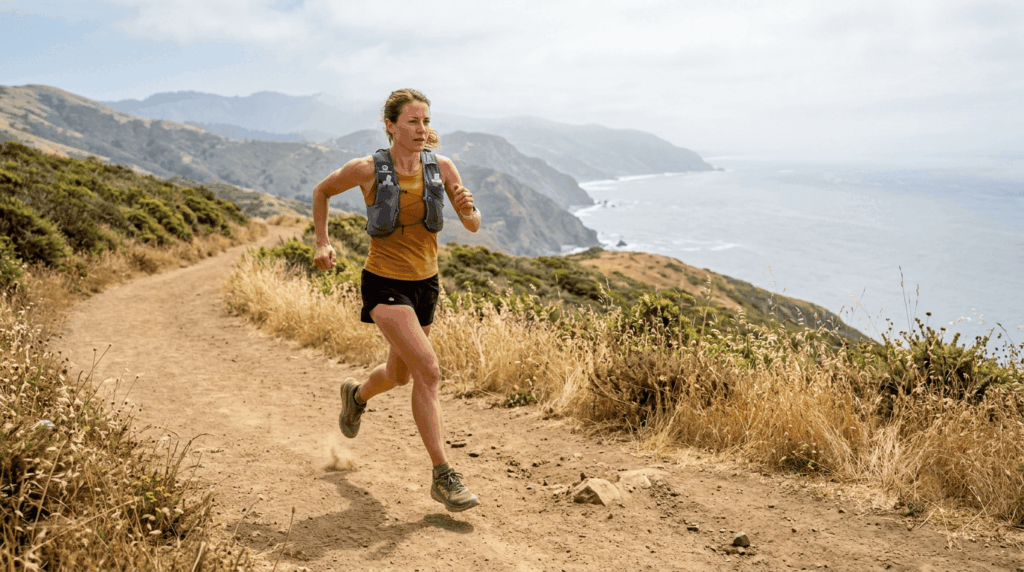
The Marin Headlands and its Tennessee Valley loop are Bay Area running staples for a reason: fast fire roads, ocean views, and enough elevation to make it count. Mount Tamalpais hosts the Dipsea Trail, a roughly 7.4-mile point-to-point route through Muir Woods with about 2,200 ft of elevation change. It’s home to the oldest trail race in America, run every June since 1905. In the East Bay, Redwood Regional Park’s trails under the Oakland hills canopy are a shadier, mellower training option.
Best trail running routes in Southern California
Runyon Canyon in LA is the classic urban-adjacent trail run, short enough for a lunch-break session but steep enough to matter, and busy enough on weekends that early mornings are worth the alarm. The Chantry Flat approach to Sturtevant Falls in the San Gabriels adds shade and water to the mix, both rare commodities on SoCal running trails.
For a genuine test, the Cactus to Clouds Trail near Palm Springs climbs roughly 10,300 ft over about 16 miles from the desert floor to San Jacinto Peak. It’s one of the toughest day routes in the country, popular with ultra-runners as a training objective, and a rite of passage for serious Southern California trail runners willing to start at 3 or 4 a.m. to beat the desert heat. Laguna Coast Wilderness Park in Orange County rounds things out with faster, rolling terrain closer to the coast for a lower-commitment session.
How to transition from hiking to trail running in California
Hikers already have the trail instincts, footwork, terrain reading, and pacing on climbs. What’s missing is the running-specific conditioning, and rushing that part is how hikers-turned-runners get hurt.
A 6-week plan to start trail running in California after hiking
Start with run-walk intervals: 30 seconds running to 2 minutes walking on a flat trail, and hold that for the first two weeks. Weeks three and four, extend the running intervals and introduce gentle elevation. By weeks five and six, you’re running sustained stretches with real climbs, at a mileage that’s still only about 20% of what you’re used to covering on a hike.
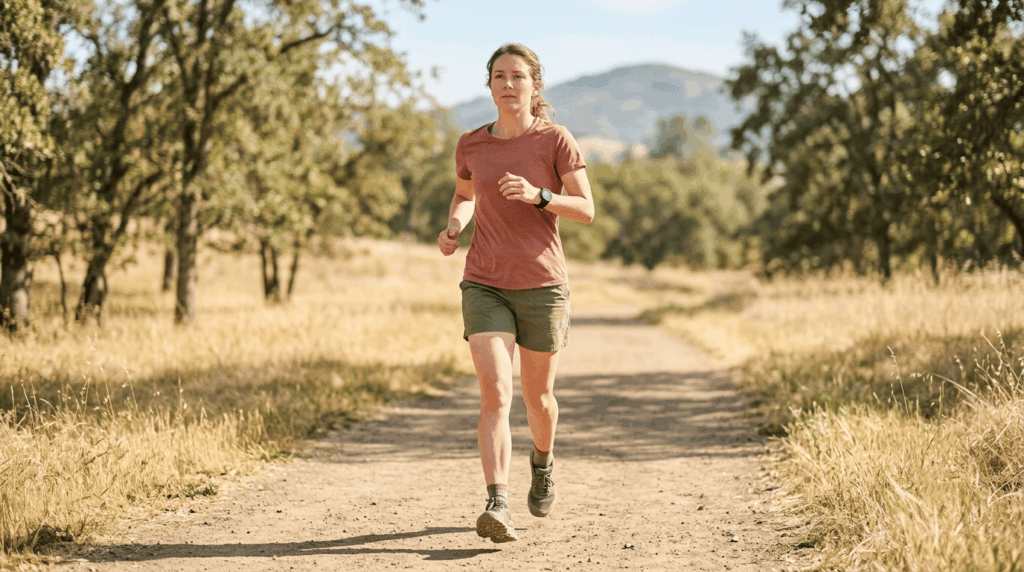
Going slower on the ramp-up than feels necessary is the whole point. Running fitness and hiking fitness use your joints differently, and the adaptation takes real weeks, not a single good training run. Always check the trail’s difficulty level before setting off to avoid accidentally running into steep, high-elevation terrain before your knees are conditioned for it.
Trail running and hiking aren’t competing for the same trail time; they’re two different tools for the same landscape. Use the shoe and pace that match what you’re actually trying to get out of the day, whether that’s a hard hour on the Marin Headlands or a slow, all-day push toward a Sierra summit. If you’re already thinking about turning that speed into overnight trips, our fastpacking guide picks up exactly where this leaves off.
Frequently asked questions about trail running vs hiking in California
Are trail running shoes good for hiking in California?
Yes, for most day hikes with a light pack on moderate terrain. Once you’re carrying real weight or crossing wet, technical ground, a stiffer hiking shoe or boot starts to earn its keep.
What is the difference between trail running shoes and hiking shoes?
Trail running shoes are lighter (6–10 oz) with a flexible, low-stack sole built for a running gait, while hiking shoes are heavier (10–16 oz) with a stiffer sole and more ankle protection built for carrying load. The choice comes down to pack weight and terrain, not personal preference alone.
Can you use trail running shoes for hiking in California?
Yes, and most day hikers do exactly that on well-maintained California trails. Save a stiffer boot for heavy packs, loose talus, or extended wet conditions.
Can you trail run in hiking boots?
You can, but the stiffer sole and extra weight work against a running gait and will slow you down. It’s a fine compromise for casual trail jogging, not for serious training.
Does trail running burn more calories than hiking?
Per hour, yes, roughly 600–900 calories against hiking’s 400–550 at the same body weight and terrain. Over a full day, hiking’s sustainable pace often wins on total calories burned simply because you can keep going longer.
Is trail running harder on the knees than hiking in California?
Trail running’s impact force (3–5 times body weight per step) creates more acute injury risk, while hiking’s toll is more cumulative, showing up as knee strain on long descents. Neither is automatically worse for your knees; it depends more on your training progression than the activity itself.