The 5 Best Redwood Hiking Trails in Mendocino County
Redwood Hiking Trails in Mendocino County’s inland don’t behave like one uniform hiking destination. This collection swings from a hushed, deliberately unmarked grove that once sheltered the tallest tree ever recorded, to a still-functioning 1930s labor camp built log by log during the Depression, to an 11-mile highway corridor better suited to a slow drive than a serious hike. Five trails, five different reasons to go, all within a short loop of Mendocino’s coast, which my dedicated coastal trails guide covers separately, with the county trail guide tying the two together.
Disclosure: Please note that some of the links below are affiliate links and at no additional cost to you, I may earn a commission. Know that I only recommend hiking gear I personally stand behind; when you use my affiliate links, it helps me run this blog and keep all of this content free of charge for readers (like you).
That variety comes with one consistent rule: none of these five trails allow dogs, largely because so much of what’s here is exactly the kind of sensitive old-growth habitat Montgomery Woods was built to protect in the first place. Plan around it before you go, especially if a four-legged hiking partner usually comes along.
Key takeaways:
- The superlative grove: Montgomery Woods: once home to the world’s tallest known tree, still genuinely massive, and consistently uncrowded.
- The two for one grove: Hendy Woods: Big Hendy and Little Hendy, each with its own character, plus a genuinely strange hermit history.
- The river and redwoods combo: Standish Hickey: old growth trees directly beside real Eel River swimming holes.
- The scenic corridor: Navarro River Redwoods: an 11 mile drive through redwood tunnel, better suited to short walks than serious hiking.
- The living history site: Mendocino Woodlands: a still-functioning 1930s CCC work relief camp, unlike anything else in this county’s coverage.
Montgomery Woods State Natural Reserve Trail
Trailhead access: free, remote, west of Ukiah
Montgomery Woods sits along narrow, winding Orr Springs Road, about 13 miles northwest of Ukiah, genuinely remote, and free, with no entrance or parking fee. Dogs aren’t allowed anywhere in the reserve, to protect sensitive habitat.
What you’ll see: a grove that once held the world’s tallest known tree
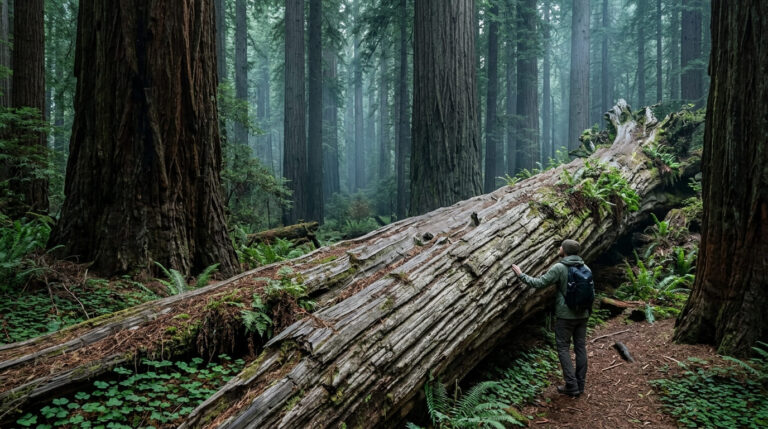
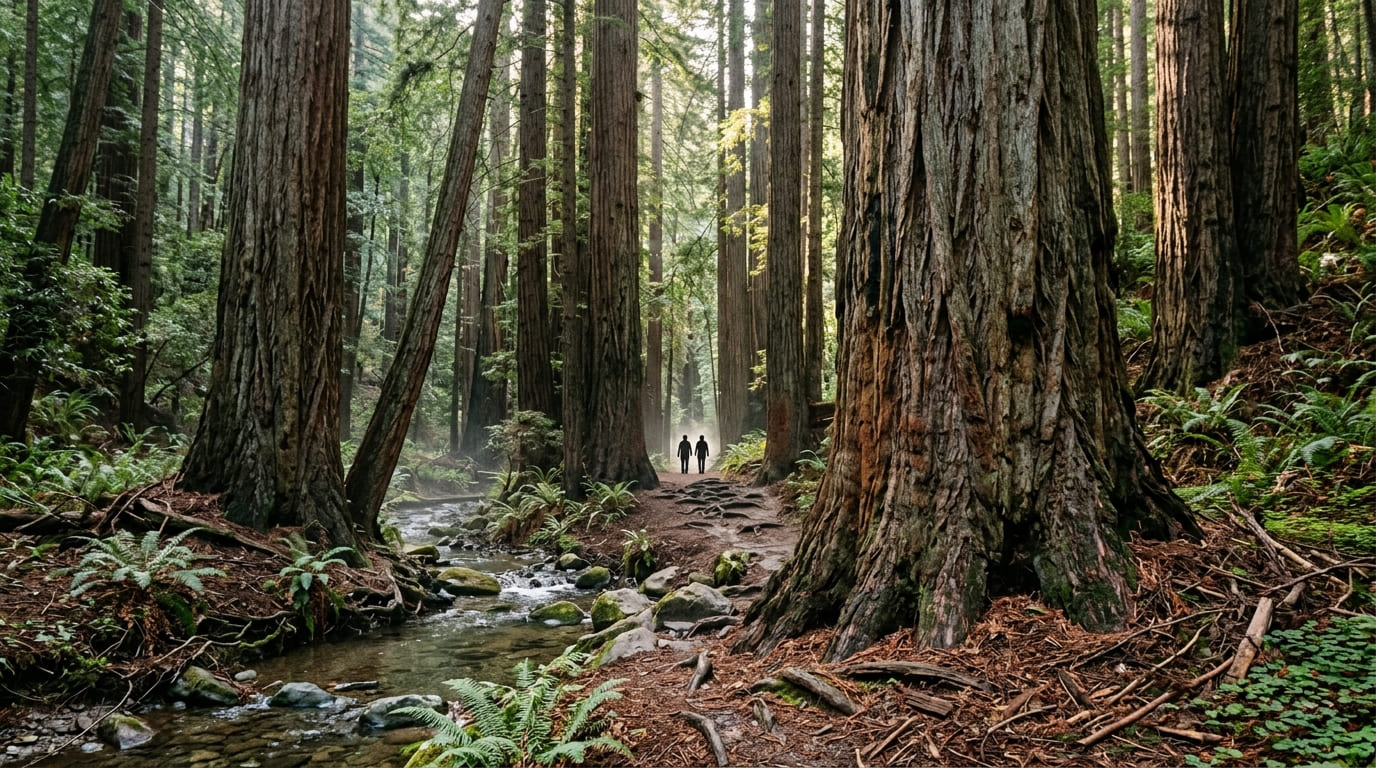
Montgomery Woods’ 367.5-foot Mendocino Tree was the world’s tallest known tree until taller specimens were found in Humboldt Redwoods State Park and, later, Redwood National Park further north; its exact location was never marked, specifically to protect it from the kind of tourist foot traffic that damaged earlier record-holding trees elsewhere.
The grove still contains 18 trees over 350 feet and 4 over 360 feet, including the Norman J. Hendry tree, among the 20 tallest documented on Earth. The main loop follows Montgomery Creek through a deep, sheltered valley, genuinely uneven underfoot, with roots and occasional mud, so it’s not a stroller or wheelchair friendly trail.
Best time to hike Montgomery Woods: any season, a genuinely quiet grove
This reserve’s remote location keeps it consistently uncrowded year-round, a real solitude advantage over the county’s more famous groves.
Hendy Woods State Park Trail
Trailhead access: a day use fee lot in Anderson Valley wine country
Hendy Woods sits about 8 miles northwest of Boonville on Highway 128, in the heart of Anderson Valley, where a standard state park day use fee applies, and camping (from $45 a night) and cabins ($70 a night) are both available.
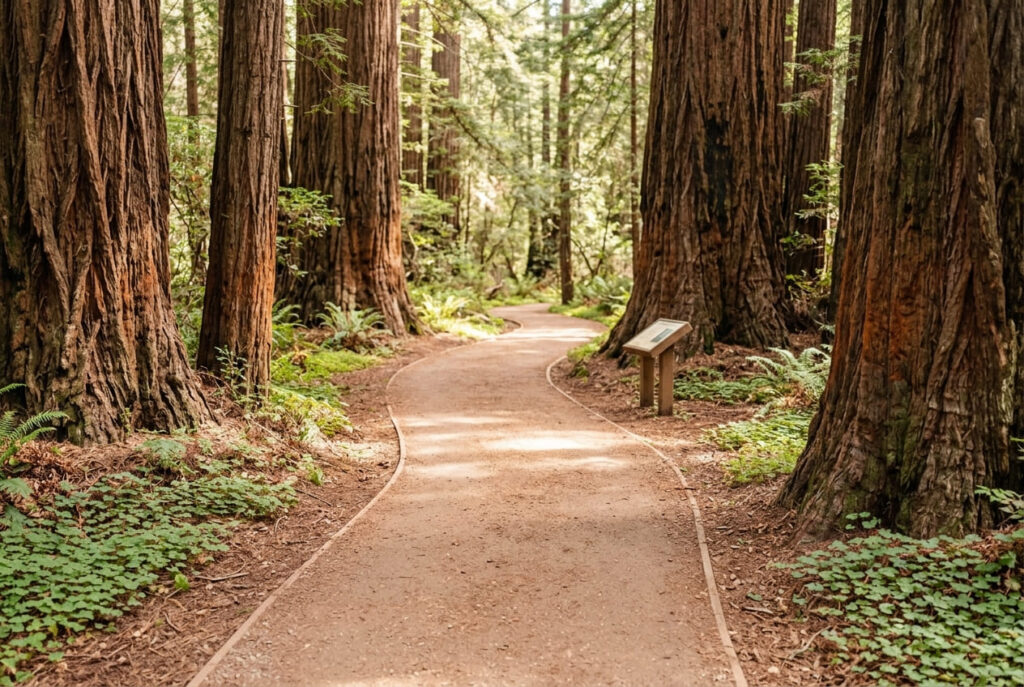
What you’ll see: two distinct old growth groves, Big Hendy and Little Hendy
Big Hendy Grove, at 80 acres, is the park’s official showpiece, with a 0.6 mile wheelchair accessible Discovery Trail and a longer 1.6-mile loop through its finest trees. Little Hendy, at just 20 acres, is smaller but holds some genuinely enormous individual specimens of its own; a connecting trail links both groves into a roughly 4.5-mile combined loop. Along the way, the Hermit Hut Trail passes the site where a Russian immigrant known locally as the “Boonville Hermit” lived alone in a downed redwood for close to two decades after World War II.
Best time to hike Hendy Woods: fall for an Anderson Valley wine pairing
Fall harvest season makes this an easy add-on to a wine tasting day trip through Anderson Valley, with cooler hiking temperatures than summer. This is also one of the busier parks in this guide, given its wine country location.
Standish Hickey State Recreation Area Trail
Trailhead access: a day use fee, near Leggett at the county’s northern edge
Standish Hickey sits 1.5 miles north of Leggett on Highway 101, marking the southern gateway to California’s “Redwood Empire.” A day use fee applies; dogs are allowed on leash in campgrounds and picnic areas but not on trails or in the river.
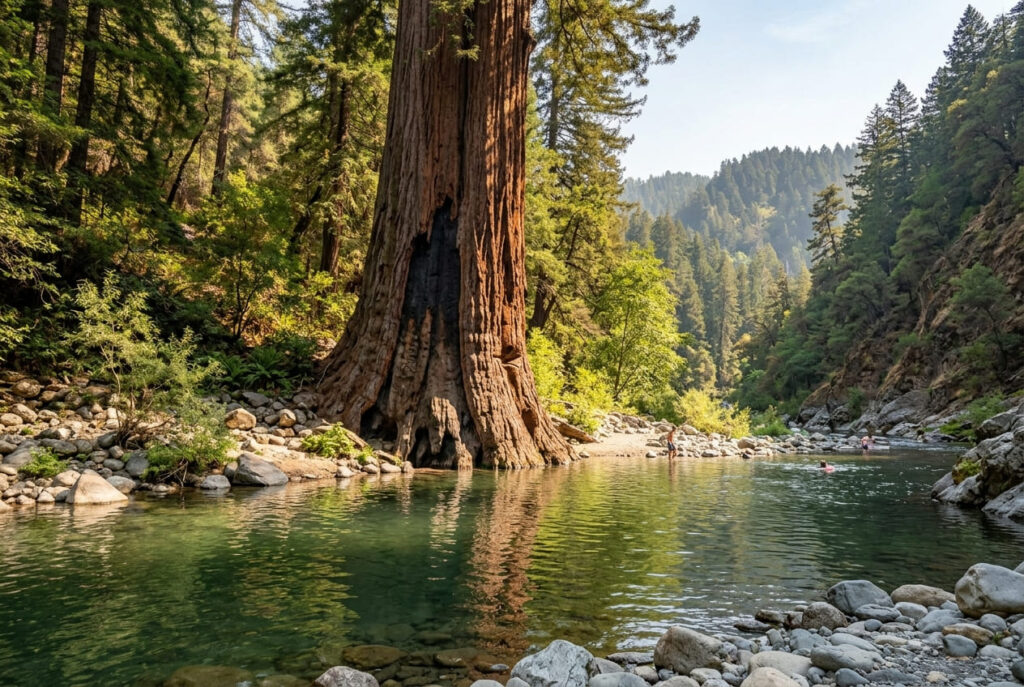
What you’ll see: old growth redwoods directly beside the South Fork Eel River
About 10 miles of trails wind through canyon bluffs, second growth forest, and pockets of genuine old growth, including the ADA compliant Grove Trail. The park’s namesake Miles Standish Tree stands 225 feet tall, 13 feet in diameter, and more than 1,200 years old, still bearing visible scars from both early logging attempts and a 1947 fire. The South Fork Eel River runs almost two miles through the park, with rapids, deep holes, and calm shallows.
Best time to hike Standish Hickey: summer for Eel River swimming holes
Summer is when the river runs low and warm enough for genuinely good swimming, a real recreational draw distinct from the pure forest hiking focus of the rest of this guide, though always check current water hazard conditions before diving in, since rapids and depth vary along the river.
Navarro River Redwoods State Park Trail
Trailhead access: free roadside pullouts along Highway 128
This narrow, 11 mile long park follows Highway 128 between Anderson Valley and the coast, with free turnouts along the way.
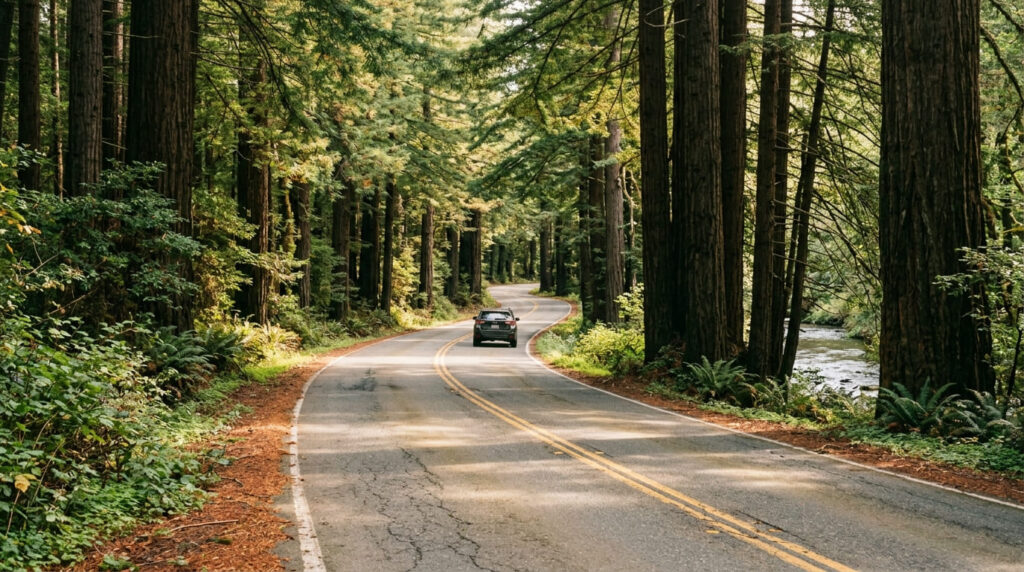
Worth knowing: the highway itself can close due to flooding during heavy rain, which affects access to the whole corridor.
What you’ll see: a redwood tunnel connecting the coast to wine country
Second growth redwoods line both banks of the Navarro River for the length of the drive, with pockets of old growth near the Paul M. Dimmick Campground specifically. Honestly, this park has short trails and informal paths rather than an extensive hiking network; it’s better suited to scenic stops, picnicking, and short walks than a dedicated hike, though swimming, fishing, and kayaking are all popular when water levels allow.
Best time to hike Navarro River Redwoods: spring for river flow and wildflowers
Spring brings both stronger river flow and wildflower bloom along the corridor, offering the best combination of scenery this drive through park offers.
Mendocino Woodlands State Park Trail
Trailhead access: free, inland from the coast, east of Mendocino village
Mendocino Woodlands sits about 7 miles east of Mendocino village, along the Little North Fork of the Big River. Trails are free and open to the public for hiking and mountain biking, even though the park’s cabin camps themselves are reserved for group bookings.
What you’ll see: a still functioning 1930s CCC and WPA work relief camp
Built between 1935 and 1942 by Civilian Conservation Corps and Works Progress Administration labor as part of the New Deal’s Recreation Demonstration Area program, Mendocino Woodlands was one of 46 such camps built nationally (including Camp David in Maryland), but it’s the only one still used for group camping, and the only one built inside a redwood forest.
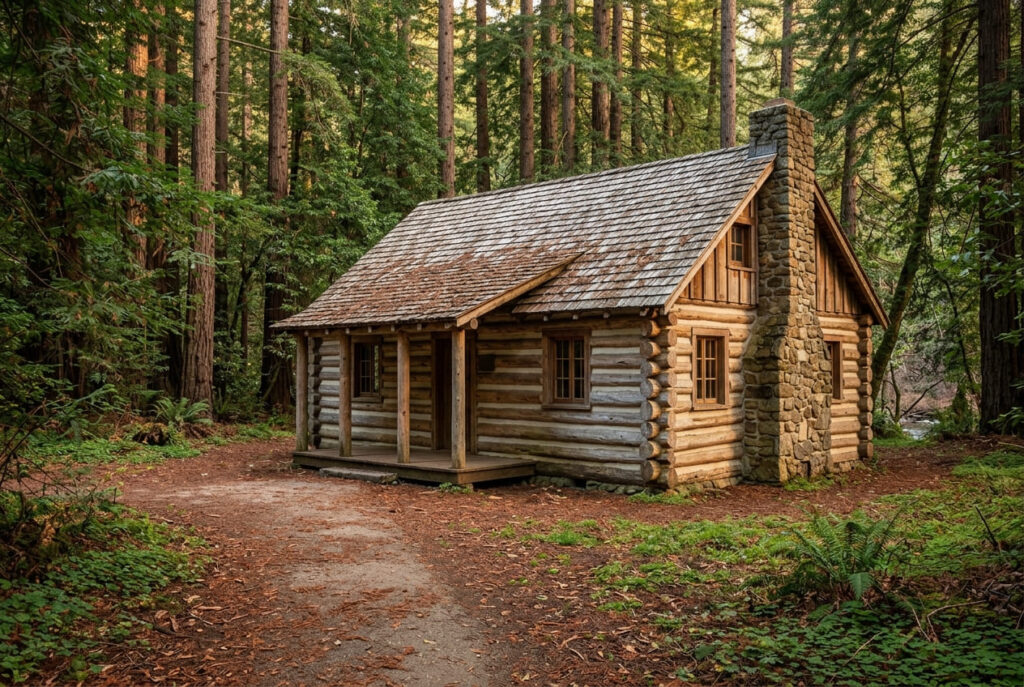
Landscape architect Daniel R. Hull, who also helped shape Yosemite, Sequoia, and Grand Canyon National Parks, designed its three camps in the National Park Service Rustic style. The park sits on traditional Pomo land, near the village site of Bu’ldam. About 25 miles of trails wind through the surrounding second growth forest.
Best time to hike Mendocino Woodlands: a quiet alternative to the county’s busier groves
This park’s low profile and lack of a single headline old growth tree keep it consistently quieter than Hendy Woods or Montgomery Woods, making it worth it for the history alone, even without a marquee grove to draw crowds.
Which of these five to hike first
If you want the single most impressive trees, Montgomery Woods delivers genuine superlatives in real solitude. If you’re combining hiking with wine country, Hendy Woods pairs naturally with an Anderson Valley day trip. And if history interests you as much as the trees themselves, Mendocino Woodlands is unlike anything else covered in this county.
Frequently asked questions
Is Montgomery Woods free?
Yes, there’s no entrance or parking fee, genuinely free, though remote enough to require a deliberate drive.
What is the difference between Big Hendy and Little Hendy?
Big Hendy is the larger grove at 80 acres, with the park’s most extensive trail network and a wheelchair accessible option; Little Hendy is smaller at 20 acres but holds some of the park’s largest individual trees.
Can you swim at Standish Hickey?
Yes, the South Fork Eel River running through the park is a popular summer swimming spot, with a range of depths from shallow riffles to deeper holes.
Is Navarro River Redwoods State Park a drive through park?
Essentially, yes, as it’s an 11-mile roadside corridor along Highway 128, better suited to scenic stops and short walks than a dedicated hiking trip.
Is Mendocino Woodlands State Park historic?
Yes, it’s a National Historic Landmark, built in the 1930s by Civilian Conservation Corps and WPA labor as one of just 46 Recreation Demonstration Areas built nationwide, and the only one still used for group camping.
Which Mendocino County redwood grove is least crowded?
Montgomery Woods and Mendocino Woodlands are both consistently quieter than Hendy Woods, thanks to remote access and a lower profile, respectively.