Nordic Walking in California: Best Trails & Technique Tips
Nordic Walking in California looks, from a distance, like hiking with poles you forgot to put away. Watch closely and it’s a completely different activity, an active push off each pole that turns a flat walk into a full-body workout, born from cross-country skiers training through the off-season in Finland. It’s grown well beyond that original niche, and California’s flattest, widest trails happen to be some of the best terrain for it anywhere in the country. Here’s what actually separates it from pole-assisted hiking, how to do the technique correctly, and where to try it.
Disclosure: Please note that some of the links below are affiliate links and at no additional cost to you, I may earn a commission. Know that I only recommend hiking gear I personally stand behind; when you use my affiliate links, it helps me run this blog and keep all of this content free of charge for readers (like you).
Key takeaways
- Nordic walking uses an active pole push, not passive balance support, trekking poles help you balance on descents; Nordic poles actively propel you forward on every stride.
- It burns roughly 20% more calories than regular walking on average, per Cooper Institute research, with some studies showing gains up to 67% depending on technique and intensity.
- It engages 80–90% of your muscles versus 50–70% for ordinary walking, since Nordic poles bring your upper body into every stride.
- Research on hip-replacement patients found Nordic walking’s joint loads comparable to regular walking, making it a genuinely low-impact option for older or rehabilitating hikers.
- Pole length uses its own formula: height in cm × 0.68, with your elbow at roughly 90 degrees when the tip touches the ground.
- California’s best Nordic walking trails are flat, wide, and paved or packed gravel, think bay trails and river parkways, not Sierra switchbacks.
What is Nordic walking and how is it different from regular hiking?
Nordic walking is a technique-specific, pole-assisted walking discipline that started as an off-season training drill for Finnish cross-country skiers, not a hiking variant, even though it shares a trail with one. The name itself points to that origin: “Nordic” walking, not “trail” walking, and the technique still traces directly back to the ski-pole push it was built to simulate.
Nordic walking vs. hiking with trekking poles: the key technique difference
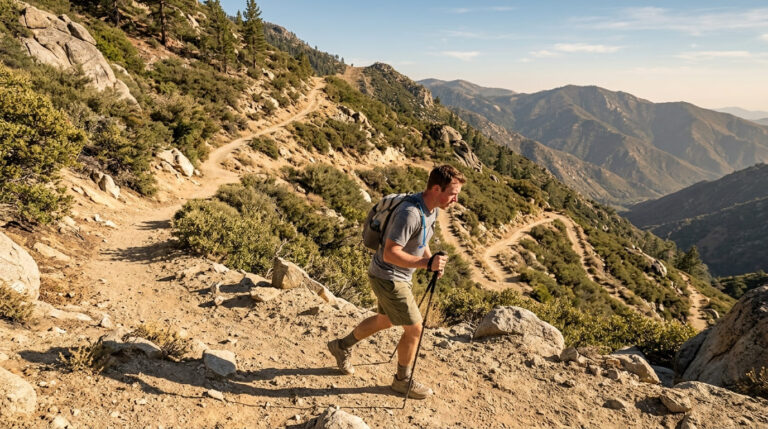
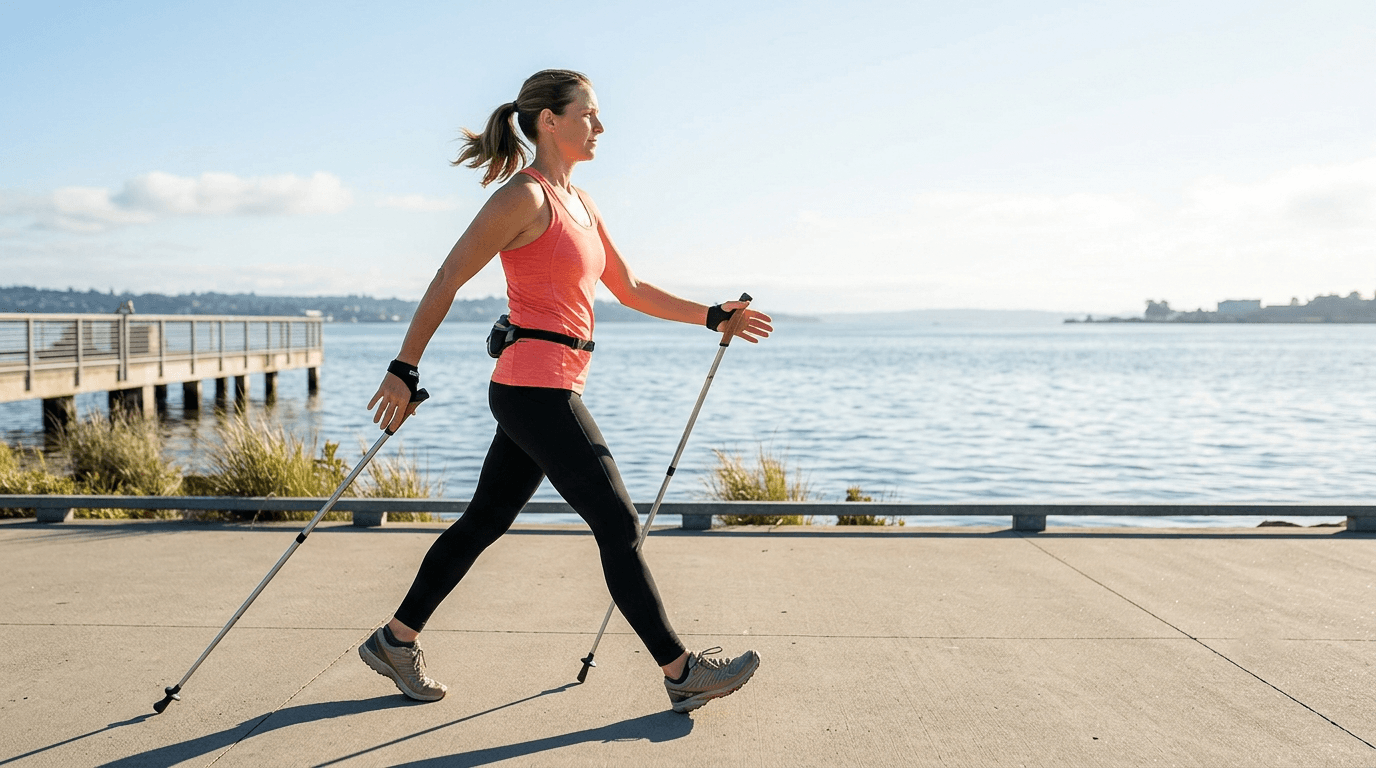
Trekking poles are used passively, mostly for balance and to take load off your knees on descents. Nordic walking poles are used actively, you push off each plant to propel yourself forward, engaging your shoulders, arms, and core on every single stride. That active push, not the poles themselves, is what actually defines Nordic walking, and it’s why simply carrying trekking poles on a flat trail doesn’t count as the same activity.
Is Nordic walking considered hiking? Where it fits in the trail activity spectrum
It’s its own activity that happens to use trails, sitting closer to a structured fitness discipline than to trail hiking in the traditional sense. It shares infrastructure with walking paths and hiking trails, but its technique, gear, and typical terrain (flat and consistent, rather than varied and technical) set it apart. For accessible, low-impact trails that also suit Nordic walking, see the accessible hiking trails guide.
The health benefits of Nordic walking on California trails
Nordic walking’s biggest selling point isn’t novelty, it’s that it turns an ordinary walk into meaningfully more exercise without feeling like it.
Why Nordic walking burns more calories than regular walking on flat California trails
The Cooper Institute found Nordic walking burns roughly 20% more calories than regular walking at the same pace, with some studies showing increases as high as 67% at higher intensity and better technique. The mechanism is straightforward: ordinary walking engages 50–70% of your muscles, while Nordic walking’s active pole push brings that up to 80–90% by adding your upper body to the work.
Nordic walking for joint health: why it’s ideal for California’s older hiking community
Research on Nordic walking in hip-replacement patients found its joint loads comparable to ordinary walking, supporting its reputation as a genuinely low-impact option even for people managing arthritis or recovering from surgery. Combined with the physical benefits of any regular walking practice, that makes it a strong fit for California’s older hiking community, specifically, real cardiovascular and strength work without the joint stress of running or steep terrain. Physical therapists increasingly recommend it for exactly this reason, as a bridge between rehabilitation and a genuine ongoing fitness habit.
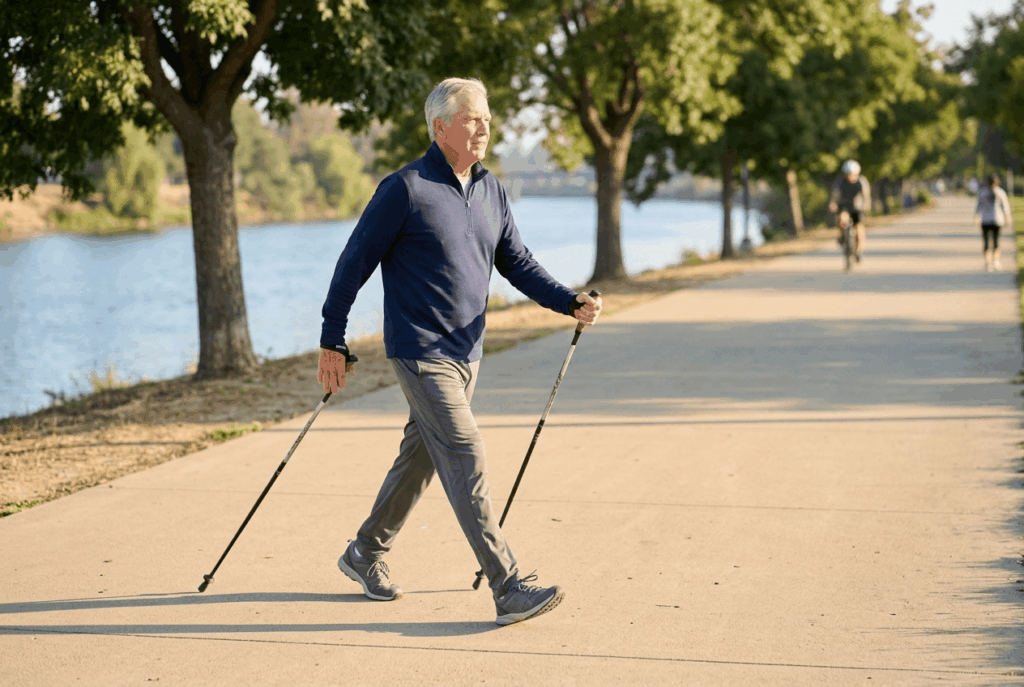
Nordic walking technique: how to do it correctly on California trails
Technique is what separates Nordic walking from “hiking with poles,” and it’s also where nearly every beginner mistake happens.
How to hold and plant Nordic walking poles: the correct grip and angle
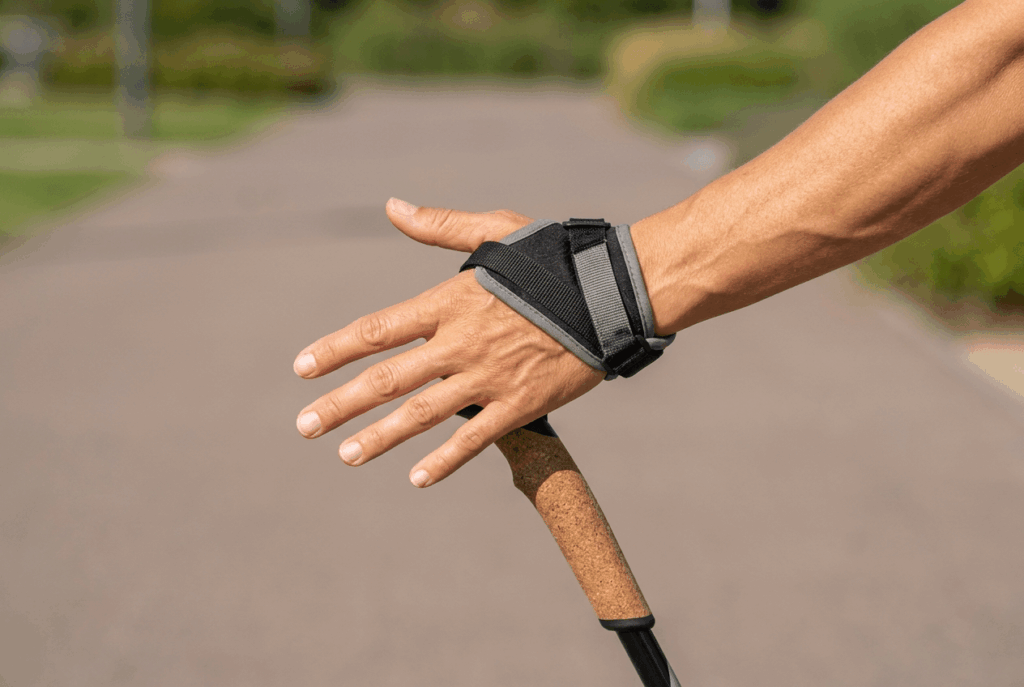
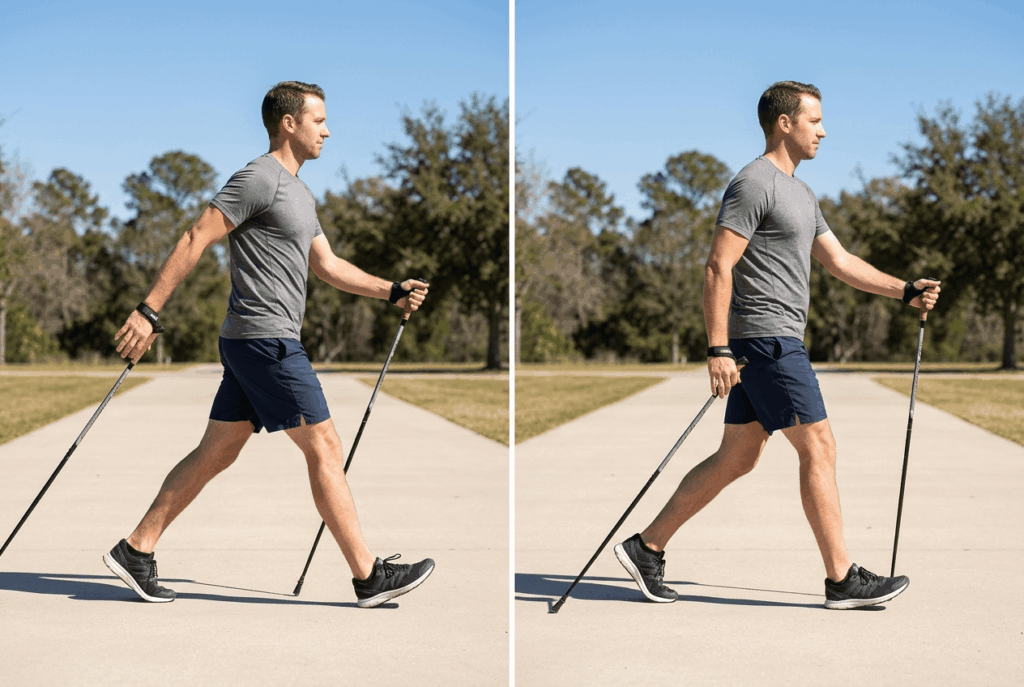
Swing your arm forward with an open, relaxed hand, then grip firmly only as you plant the pole at roughly a 45-degree angle behind your hip, not out in front of you. The wrist strap does real work here, acting as a lever that lets you push off without gripping the handle tightly the whole time.
Common Nordic walking technique mistakes and how to fix them
Planting the pole in front of your body instead of behind your hip is the most common error, and it turns an active push into a passive plant that does nothing for calorie burn. Gripping too tightly the entire stride, skipping hip rotation, and using poles that are the wrong length round out the usual list, all four are fixable by slowing down and rebuilding the motion deliberately, rather than trying to walk at full pace while learning. Most instructors suggest practicing the arm swing and plant without even moving forward first, then adding steps once the motion feels automatic.
Nordic walking poles: how they differ from hiking trekking poles
Nordic walking poles and trekking poles look similar enough to grab the wrong one by accident, but the design differences matter for technique, not just aesthetics.
How to choose the right Nordic walking poles for California trails
Use the standard sizing formula, height in cm × 0.68, as your starting point, then check it against the 90-degree elbow test with the tip on flat ground: plant the pole vertically, and your elbow should sit at roughly a right angle. Nordic walking poles typically come with a fixed length (rather than the adjustable telescoping design common on trekking poles), a rubber “paw” tip for pavement that swaps out for a carbide spike on dirt, and a glove-style strap built for the active push-off, unlike a standard trekking pole’s simpler wrist loop. Cork or foam grips both work well; the difference is mostly comfort and moisture handling over a long session, rather than performance.
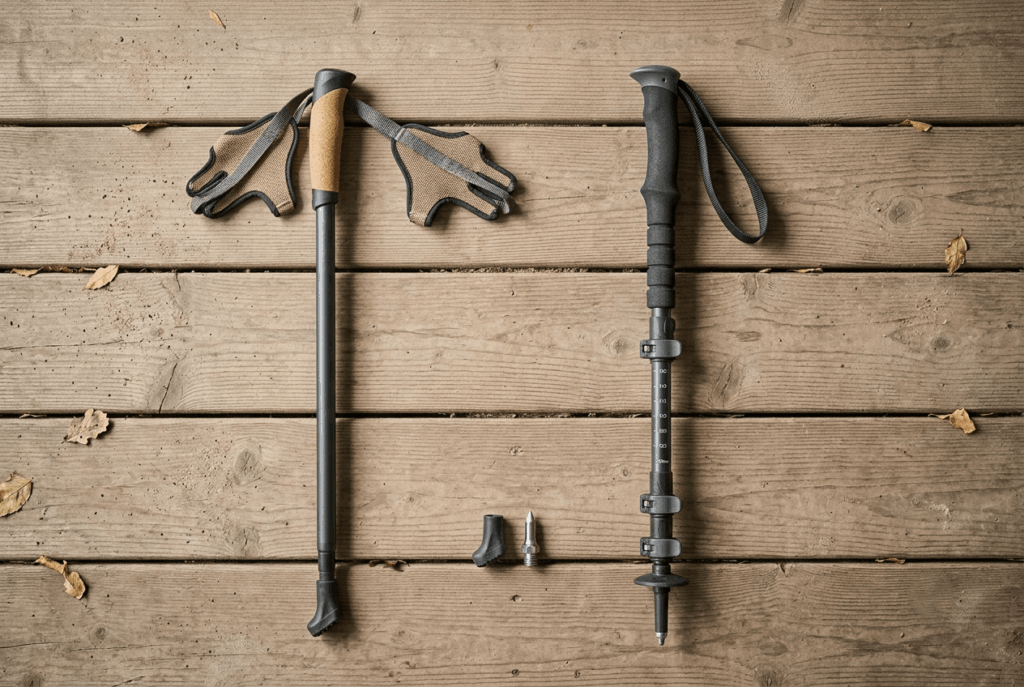
For a side-by-side comparison of Nordic poles and standard trekking poles, see the full hiking gear checklist.
Best trails for Nordic walking in California
The best Nordic walking terrain is flat to gently rolling, on a paved or packed-gravel surface wide enough to swing poles without hitting other trail users. These trail types are also described in the California trail types guide.
Best Nordic walking trails in Northern California
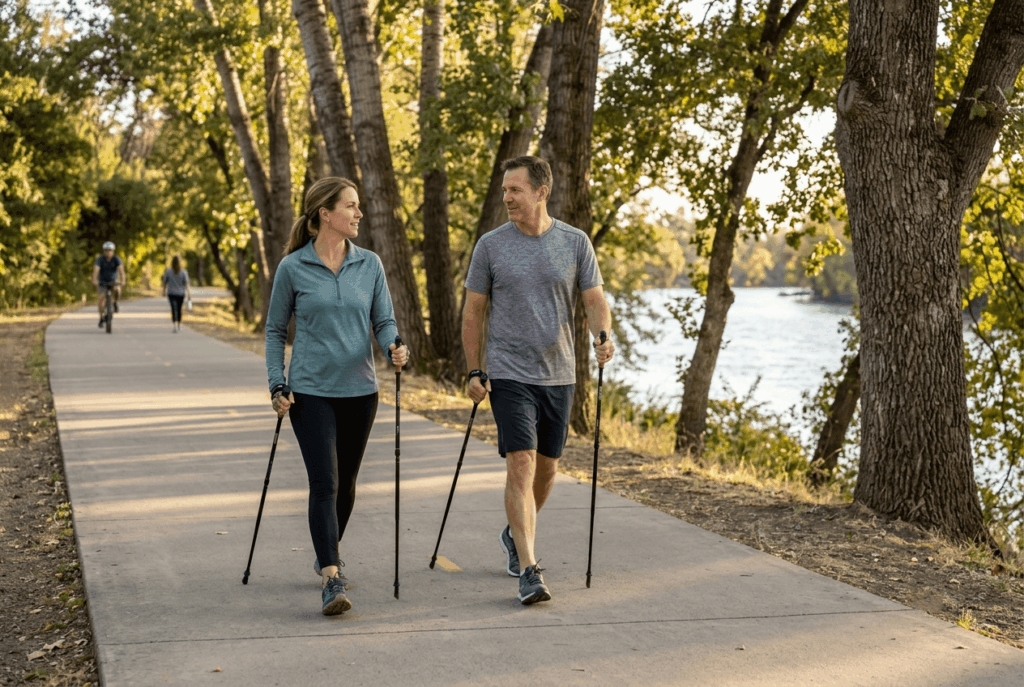
The Bay Trail offers miles of flat, paved waterfront route around the Bay Area, the Sacramento River Parkway provides a similar flat riverside option, and Marin County’s fire roads and Sonoma Valley’s trail networks add rolling, scenic alternatives without technical terrain. All four give you enough distance to build a real Nordic walking session without doubling back constantly.
Best Nordic walking trails in Southern California
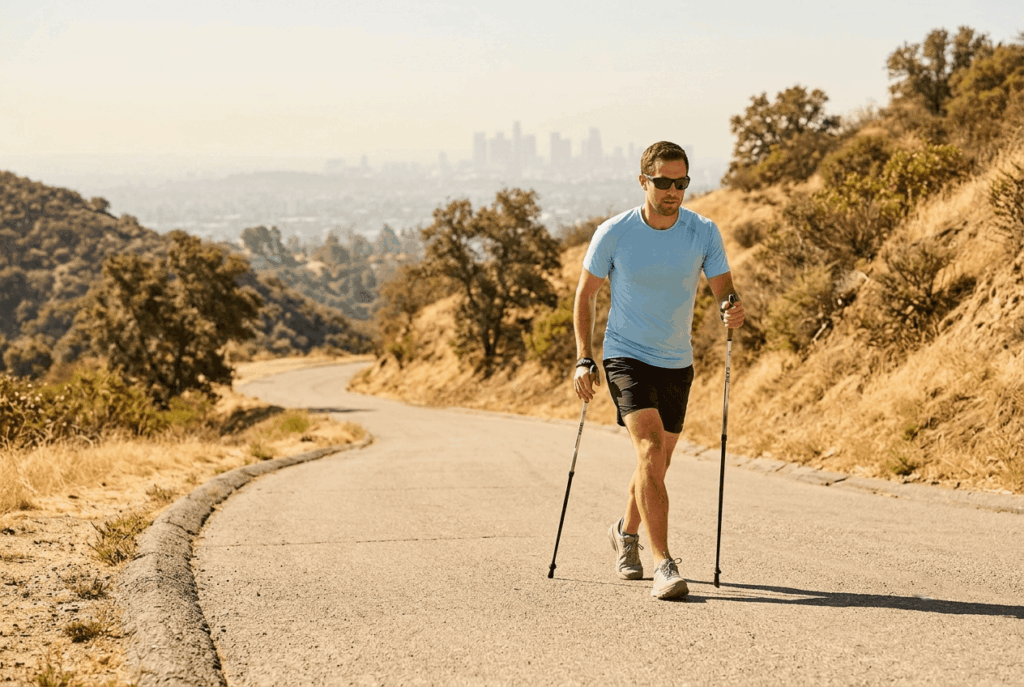
The LA River Trail and Griffith Park’s paved roads both offer wide, consistent surfaces well suited to Nordic walking, while Balboa Park’s pathways and Mission Trails Regional Park in San Diego round out solid Southern California options with easy parking and reliable trail conditions. Griffith Park specifically is worth calling out for elevation options, its paved roads let you add rolling terrain once flat trails start feeling too easy.
Nordic walking rewards a small technique investment with a genuinely different workout than the trail alone provides, more muscle engagement, more calorie burn, and a joint-friendly profile that works for hikers who’ve aged out of harder terrain or never wanted it in the first place. Get the pole length and push-off technique right, pick a flat, wide trail to start, and the rest follows quickly.
Frequently asked questions about Nordic walking in California
Is walking a trail considered hiking?
Generally yes, in casual use, but activities like Nordic walking carve out their own identity through technique and gear even while using the same trails as hikers.
Are trail running shoes good for walking and everyday wear?
Yes, for most people, their lighter weight and flexible sole suit both Nordic walking and daily wear well, though they offer less ankle support and durability than a dedicated hiking shoe on rougher terrain. See the best hiking shoes guide for a full comparison.
What is Nordic walking and how is it different from regular hiking?
Nordic walking is a technique-specific, pole-assisted walking discipline using an active push-off with each stride, developed from cross-country ski training. Regular hiking has no required technique or pole use at all.
Do I need special poles for Nordic walking, or can I use hiking poles?
Dedicated Nordic walking poles work best, since their fixed length, rubber paw tips, and glove-style straps are built for the active push-off technique. Standard trekking poles can work in a pinch but won’t support proper technique as well.
How many calories does Nordic walking burn compared to regular walking?
Roughly 20% more on average, according to Cooper Institute research, with some studies showing gains up to 67% at higher intensity and with strong technique.
Is Nordic walking good exercise for seniors or people with bad knees?
Yes, research on joint loading found it comparable to ordinary walking, making it a low-impact way to get real cardiovascular and upper-body exercise without the strain of running or steep terrain.