The 5 Best Hiking Trails in Sequoia National Park’s Giant Forest, From the Largest Tree on Earth to a 400-Step Granite Staircase
This is the flagship guide for Tulare County, and it covers Giant Forest, the heart of Sequoia National Park, while highlighting its most iconic Sequoia National Park attractions. Here’s the short version: General Sherman is the tree everyone comes to see, Moro Rock is the trail that turns a short walk into a thrill, and Big Trees Trail is the one to close your visit on if you want an easy, fully accessible walk among the same giant sequoias. Following these iconic Hiking Trails Sequoia National Park holds is the perfect way to witness the sheer scale of the world’s largest trees.
Disclosure: Please note that some of the links below are affiliate links and at no additional cost to you, I may earn a commission. Know that I only recommend hiking gear I personally stand behind; when you use my affiliate links, it helps me run this blog and keep all of this content free of charge for readers (like you).
Five trails anchor this guide, all within the Giant Forest area and reachable from the same general stretch of Generals Highway, especially if you plan ahead with a Sequoia winter guide. I’ll flag current fees, real step counts, and one significant 2026 policy change before you plan a trip around any of them.
Key takeaways
- The world’s largest tree: General Sherman Tree Trail, the largest living single-stem tree on Earth by volume, still growing every year.
- The thrilling granite staircase: Moro Rock Trail, 350-plus steps carved into solid rock, ending in a 360° Sierra panorama.
- The “Gem of the Sierra”: Crescent Meadow to Tharp’s Log, John Muir’s favorite meadow, plus a pioneer’s hollowed-out log cabin.
- The fuller sequoia tour: Congress Trail, a paved loop connecting General Sherman to the President Tree, the world’s third-largest tree by volume.
- The easiest, most accessible option: Big Trees Trail, a boardwalk loop around Round Meadow, comfortable for nearly any visitor.
- A significant fee change took effect January 1, 2026: non-U.S. residents without an annual pass now pay a $100-per-person surcharge on top of the standard entrance fee. Dogs and bikes are prohibited on every trail in this guide.
General Sherman Tree Trail
Trailhead access and parking at the Giant Forest Museum or Wolverton (park entrance fee)
The standard Sequoia and Kings Canyon National Parks entrance fee applies: $35 per vehicle for 7 days, or free with an $80 America the Beautiful annual pass.
As of January 1, 2026, non-U.S. residents without an annual pass pay an additional $100 per person. The main trailhead lot sits off Wolverton Road, with a separate accessible parking area about 2.2 miles north of the Giant Forest Museum, directly off Generals Highway.
What you’ll see: the largest tree on Earth by volume
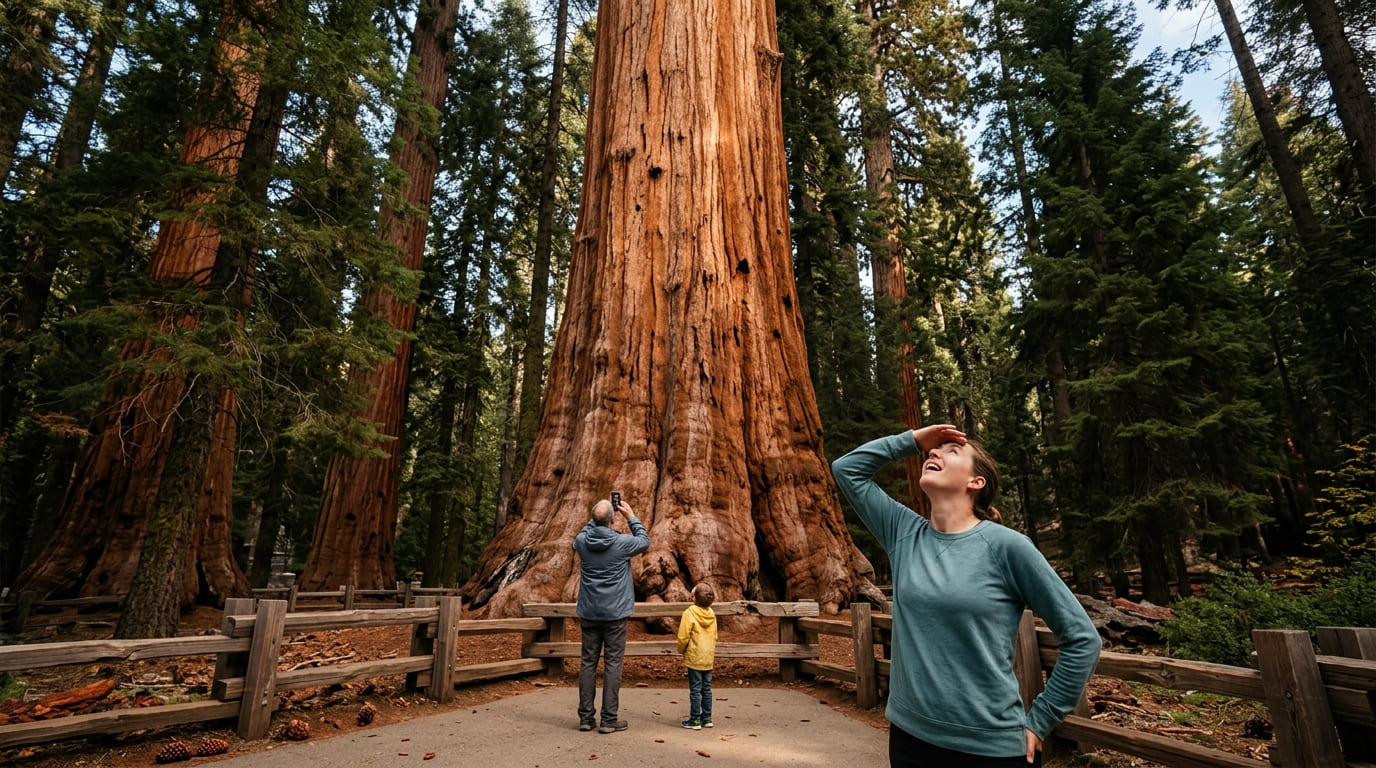
A short paved trail, roughly 0.5 miles one-way, 0.8 to 1 mile round trip, leads to the General Sherman Tree: 275 ft tall, 36 ft in diameter at its base, with a 103-ft circumference.
It’s the largest living single-stem tree on Earth by trunk volume, and it’s still growing, adding roughly 0.4 inches of diameter every year, enough new wood annually to equal the mass of an entire 60-ft tree. No dogs or bikes are permitted on this or any trail in the park.
Best time to hike General Sherman Tree Trail: early morning to beat tour bus crowds
This is one of the most-visited single attractions in the entire national park system; arriving at 6:30 or 7 a.m. can mean having the tree nearly to yourself, compared to a packed viewing area by 11 a.m.
Moro Rock Trail
Trailhead access and parking along the Moro Rock/Crescent Meadow Road
A small trailhead lot near Moro Rock, reached via Crescent Meadow Road just south of the Giant Forest Museum, holding only about 20 vehicles. From Memorial Day through Labor Day, private vehicles are restricted here on weekends specifically, requiring the free shuttle from Giant Forest Museum; weekdays remain open to private cars.
What you’ll see: a 400-step granite staircase to a 360° Sierra panorama
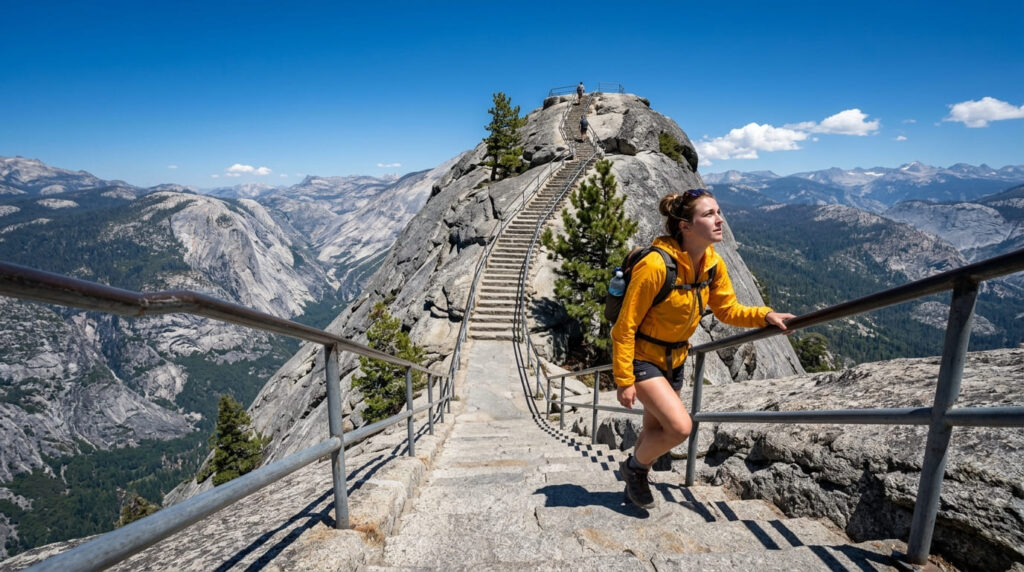
A dramatic staircase carved directly into granite climbs 350 to 400-plus steps (elevation gain cited anywhere from 180 to 300 ft, depending on the source) to the summit of Moro Rock, a granite dome that began forming 100 million years ago. At the top, a real 360° panorama takes in the Great Western Divide and, on clear days, stretches out over the Central Valley.
Best time to hike Moro Rock: clear days; avoid during thunderstorms
This fully exposed granite dome carries a lightning-strike risk during Sierra summer thunderstorms, a real safety consideration, not just a comfort preference. Check the forecast and turn back at the first sign of building storms.
Crescent Meadow to Tharp’s Log Trail
Trailhead access and parking at Crescent Meadow
A seasonal shuttle-served trailhead at the end of Crescent Meadow Road, the starting point for one of Giant Forest’s most beloved easy loops, often called the park’s “second attraction” after General Sherman itself.
What you’ll see: the meadow John Muir called the “Gem of the Sierra,” and a pioneer’s log cabin
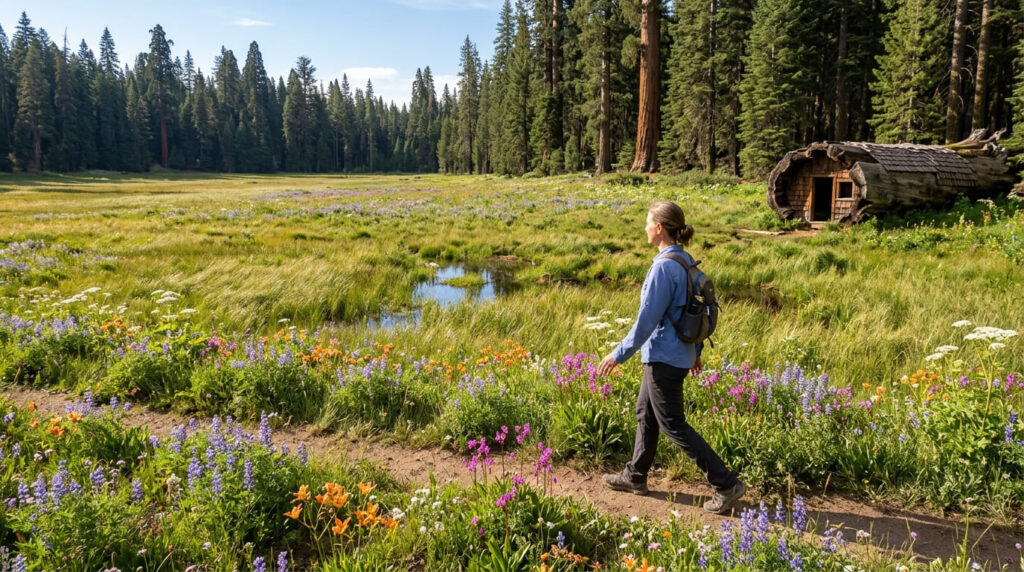
Crescent Meadow earned naturalist John Muir’s famous description as the “Gem of the Sierra.” A short walk leads to Tharp’s Log, a fallen, hollowed-out giant sequoia that early settler Hale Tharp actually used as a cabin, one of the more remarkable pieces of pioneer history anywhere in the Sierra.
Best time to hike Crescent Meadow: summer for wildflowers
Summer brings this open meadow’s fullest wildflower bloom, the clear seasonal highlight for this specific trail, distinct from the year-round appeal of the paved sequoia-grove trails elsewhere in this guide.
Congress Trail
Trailhead access and parking at the General Sherman Tree area
Departs directly from the same trailhead as General Sherman, extending into a longer paved loop through the surrounding grove, the standalone Congress Trail runs roughly 2 miles, though it’s commonly combined with the Trail of the Sequoias and Circle Meadow for a fuller 7-plus-mile day.
What you’ll see: a paved loop connecting several of the world’s largest trees
Beyond General Sherman itself, this loop passes the President Tree, the world’s third-largest giant sequoia by volume, along with other named monarchs like the Chief Sequoia Tree, giving hikers a fuller sense of Giant Forest’s scale beyond a single famous tree.
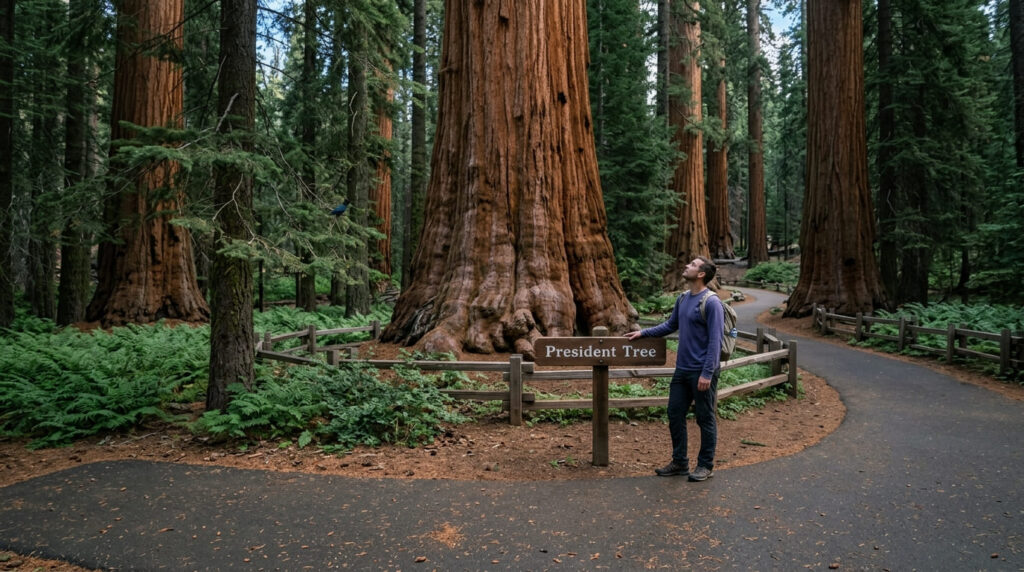
Best time to hike Congress Trail: a reliable paved, accessible option
This trail’s fully paved surface keeps it comfortable and accessible across virtually the entire year, and for a wide range of mobility levels, a dependable choice whenever the weather or crowd conditions elsewhere in the park aren’t cooperating.
Big Trees Trail (Round Meadow)
Trailhead access and parking at the Giant Forest Museum
A fully accessible trailhead directly at the Giant Forest Museum, the most universally accessible trail in this entire guide.
What you’ll see: a fully accessible boardwalk loop around a sequoia-ringed meadow
A flat, mostly paved loop with boardwalk sections circles Round Meadow, passing the Sentinel Tree and Clara Barton Tree along the way, with interpretive displays explaining sequoia ecology. Watch for black bears, yellow-bellied marmots, and deer, especially early or late in the day when the meadow is quietest.
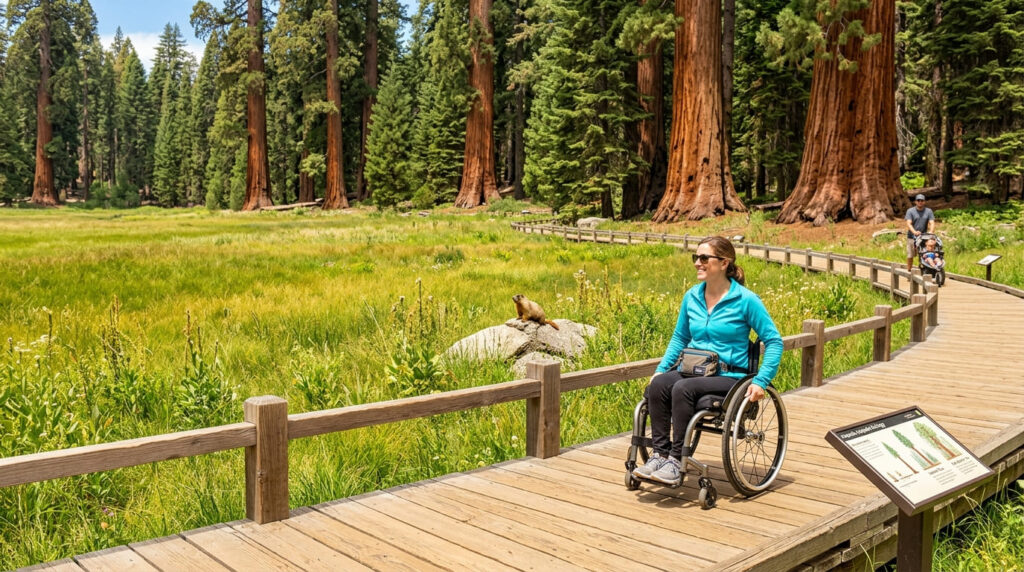
Best time to hike Big Trees Trail: any season, a reliable accessible option
Minimal elevation change and a paved-boardwalk surface make this comfortable virtually year-round, snow permitting, a strong choice to close out a Giant Forest visit regardless of when you’re there.
The trail I’d actually start with
If you’ve only got time for one stop, make it General Sherman Tree; nothing else in the park carries its singular significance, and arriving early solves the crowd problem entirely.
Congress Trail is the natural next step once you want more sequoias beyond the one famous tree, and Moro Rock is worth the climb specifically for the panorama, weather permitting. Crescent Meadow rewards a summer visit, and Big Trees Trail is the easy, reliable closer for any visitor at any fitness level.
For waterfalls spanning Sequoia’s high country and foothills, a deliberately different focus from this guide’s sequoia-grove coverage, my Tulare County waterfall trails guide is the natural next stop, and my Tulare County hiking guide rounds out everything else the county offers.
Frequently asked questions
What hiking trail is closest to General Sherman?
Congress Trail, it departs directly from the same trailhead as General Sherman Tree Trail, making it the easiest add-on for anyone already there.
How big is the General Sherman Tree?
275 ft tall, 36 ft in diameter at its base, with a 103-ft circumference, the largest living single-stem tree on Earth by trunk volume, and it’s still growing every year.
Is Moro Rock scary to climb?
It can feel that way for some; the 350-plus-step staircase includes real exposure along steep drop-offs, though sturdy railings line the route throughout. It’s more a thrill than an actual technical danger when dry and free of storms.
Is Congress Trail paved?
Yes, fully, making it one of the most accessible, reliable trails in this entire guide across nearly any season.
Do you need a permit to hike in Sequoia National Park?
Not for any of the five day-hike trails in this guide, just the standard park entrance fee. Wilderness permits are only required for overnight backcountry trips deeper into the park.
Which Giant Forest trail is best for a quick visit?
General Sherman Tree Trail, at under a mile round trip, it delivers Sequoia’s single most iconic sight in the shortest possible time.