Best GPS Watches for Tracking California Hikes
Before recommending GPS Watches for Hiking Trails, it’s worth asking honestly whether you need one at all. If your phone already has an offline map downloaded and you’re doing day hikes with decent cell coverage on the drive in, a GPS watch is a nice-to-have, not a safety requirement. Where it earns its place is multi-day trips, wilderness-permit routes, and anywhere battery life on a single device actually matters- situations where a dead phone means a dead map, and where our guide on what to do if you get lost on a California trail becomes a lot more relevant than it should be.
Disclosure: Please note that some of the links below are affiliate links and at no additional cost to you, I may earn a commission. Know that I only recommend hiking gear I personally stand behind; when you use my affiliate links, it helps me run this blog and keep all of this content free of charge for readers (like you).
I’ve narrowed this down to four watches that each solve a different version of that problem, plus a straight answer on which one is overkill for what you’re actually doing. None of these are cheap, and the honest framing throughout is value relative to the trips you take, not the expedition you might do someday. For those shopping for high-end tech or accessories, our curated list of outdoor enthusiast gift recommendations features top-tier gear.
Key takeaways:
- Best premium pick for multi-day treks: Garmin Fenix 7, offline topo maps and long battery life, now at a real discount now that the Fenix 8 exists.
- Best budget option: Garmin Instinct 2, rugged, reliable GPS tracking at a fraction of the Fenix price, especially now that it’s a previous-generation model.
- Best battery life for extended backcountry trips: Coros Vertix 2S, over 100 hours of continuous GPS tracking, built for trips where charging isn’t an option.
- Best crossover option: Apple Watch Ultra 3, outdoor GPS credibility in a watch that still works as your everyday smartwatch.
- The honest baseline: if you’re only ever day-hiking with cell service nearby, a phone app covers you; save the GPS watch budget for when you’re off-grid.
| Watch | Best for | Price | GPS battery life | Offline maps |
|---|---|---|---|---|
| Garmin Fenix 7 | Multi-day treks, wilderness permits | $450–550 | Up to ~57 hrs (longer in saver modes) | Yes, full topo |
| Garmin Instinct 2 | Budget day-hike tracking | $187–275 | Up to ~30 hrs | GPX tracks only, no full maps |
| Coros Vertix 2S | Extended backcountry trips | $699 | Up to 118 hrs | Yes, global offline maps |
| Apple Watch Ultra 3 | Daily use + trail crossover | $799 | ~34–36 hrs | Limited vs. dedicated GPS watches |
Garmin Fenix 7: best premium GPS watch for multi-day treks
Key features
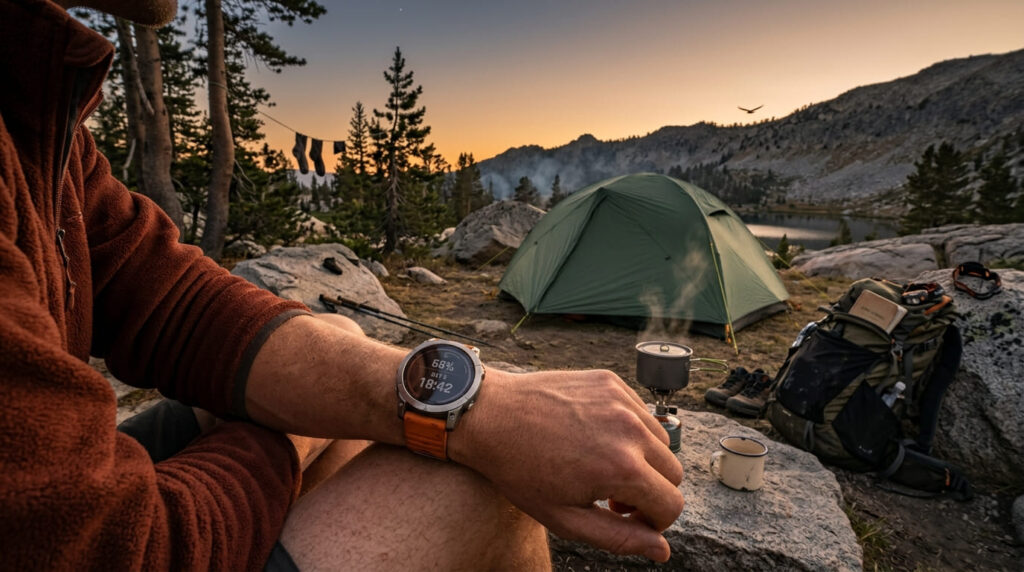
The Fenix 7 pairs full offline TopoActive maps with long battery life; figures vary by exact model and settings, but expect roughly a week or more in basic smartwatch mode, over two days in full GPS-tracking mode, and considerably longer in battery-saving Expedition mode, which records position at wider intervals to stretch a charge across a multi-day trip.
Multi-band GPS on Sapphire models improves accuracy in tree cover and canyon terrain where single-band GPS can drift. Garmin has since released the Fenix 8 at $999 and up, and early reviews note a buggier interface than the proven Fenix 7, which is part of why the Fenix 7 remains the smarter buy for most hikers rather than a compromise pick.
Best for
Serious backpackers attempting wilderness-permit routes where battery life and mapping reliability matter most, multi-day trips through the Desolation Wilderness, our Eastern Sierra high-altitude trail guide, or our high-elevation Fresno County trail guide, the kind of terrain covered in our guide to the best multi-day backpacking loops in California. For an occasional day hiker, this is more watch and more money than you need.
Garmin Instinct 2: best budget GPS watch
Key features
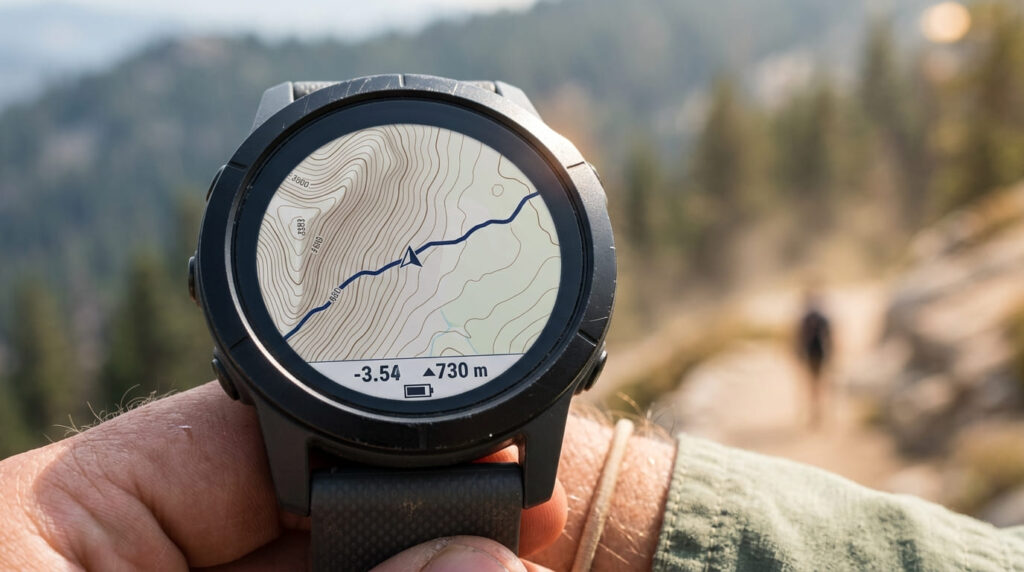
The Instinct 2 strips away the Fenix’s touchscreen and full offline mapping for a simpler, rugged package built to MIL-STD-810 standards. It still tracks GPS reliably and can load GPX tracks for basic route-following, just without the full topo map display- a real trade-off, but one that matters less on well-marked day-hike terrain than on true backcountry navigation.
Battery life runs up to roughly 28 days in smartwatch mode and about 30 hours in continuous GPS mode, an impressive figure for the price point and one of the main reasons this watch has held onto a loyal following years after launch.
Now that Garmin has moved on to the Instinct 3, the Instinct 2 has dropped meaningfully in price, which only strengthens its case as the budget pick here.
Best for
Day hikers working through this site’s county-level trail guide who want reliable GPS tracking without paying for multi-day expedition features they won’t use, think our San Diego guide covering every skill level rather than a week in the backcountry. If you’re mapping out a route ahead of time and just need to confirm you’re on it, this covers that without the Fenix’s price tag.
Coros Vertix 2S: best battery life for long backcountry trips
Key features
Battery life is the entire reason to choose this watch: up to 118 hours of continuous full GPS tracking, and roughly 36 days of regular daily use between charges. Global offline maps come standard, dual-frequency GPS holds up well in narrow canyons and dense tree cover, and the titanium bezel with sapphire screen is built for abuse.
Coros released the Vertix 2S as a direct successor to the original Vertix 2 at the same $699 price, with an improved antenna and heart-rate sensor; there’s no real reason to seek out the older model when the 2S costs the same.
Best for
Extended trips where charging opportunities are scarce for days at a stretch, a thru-hike through our Big Basin Redwoods guide toward the coast, or any multi-day route from our guide to the best multi-day backpacking loops in California where you won’t see an outlet for a week. If your trips rarely exceed a few days, the Fenix 7’s shorter-but-still-substantial battery life is probably enough, and cheaper.
Apple Watch Ultra 3: best smartwatch crossover option
Key features
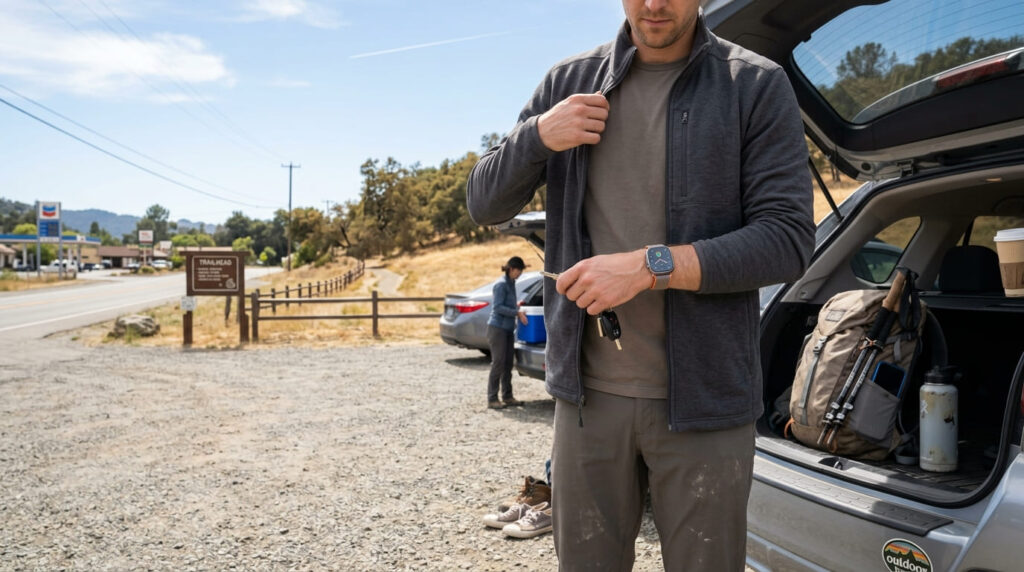
The Ultra 3 pairs dual-frequency GPS; independent testing has clocked its accuracy within a couple of percent of dedicated Garmin devices, with the full Apple Watch software experience: calls, texts, apps, and satellite SOS messaging that works even fully off the grid.
The trade-off is battery life: roughly 34–36 hours of typical use, a fraction of what the dedicated hiking watches above offer, which means multi-day trips require real power management rather than the “forget about it” approach the Fenix or Vertix allow.
Best for
Casual to moderate hikers working through day-hike-focused county guides who want one watch that handles both daily life and trail tracking, rather than carrying a dedicated GPS watch just for weekends making versatile tech gear a popular standout among holiday presents for outdoor guys.
If you’re already deep in the Apple ecosystem and mostly day-hiking, this covers the GPS need without a second device on your wrist; just charge it more often than you would a Garmin or Coros.
Frequently asked questions about the best GPS watches for tracking California hikes
Does a Garmin work for hiking trails without cell service?
Yes, GPS positioning doesn’t require cell service at all, since it works off satellite signals rather than cell towers. What does require planning is having offline maps downloaded before you lose signal, since a Garmin without a preloaded map (or a model that doesn’t support full topo maps, like the Instinct 2) can still track your position but won’t show you the surrounding terrain. Download maps for the specific region you’re hiking before you leave cell coverage, not after. Garmin’s map downloads require a Wi-Fi or Bluetooth connection that won’t be available once you’re on the trail.
Do you need a GPS watch if you already use a hiking app?
Not necessarily; for most day hikes, a phone with an offline map covers the same core need. A GPS watch earns its place when phone battery life becomes the limiting factor, particularly on multi-day trips, or when you want navigation on your wrist without pulling your phone out repeatedly. There’s also a redundancy argument worth considering: a watch and a phone running independently means a single dropped or cracked device doesn’t leave you without navigation entirely.
How accurate are GPS watches compared to phone apps?
Modern dual-frequency and multi-band GPS watches generally match or slightly exceed phone GPS accuracy in challenging conditions like dense tree cover or narrow canyons, though the gap is smaller than it used to be. For most day-hike terrain, the practical difference is minimal; it widens on technical, exposed, or heavily forested routes.
Can a GPS watch replace a satellite communicator?
No, even watches with satellite SOS features, like the Apple Watch Ultra 3, are designed for emergency messaging, not the full two-way communication and dedicated emergency response coordination a proper satellite communicator provides. The NPS’s own Ten Essentials list specifically calls out a two-way satellite messaging device as a separate item from basic navigation gear; treat a GPS watch’s SOS feature as a backup layer, not a replacement.
Do GPS watches work in deep canyons or forests?
They work, but accuracy can degrade in terrain that blocks a clear view of the sky; deep canyons and dense forest canopy are the two situations where any GPS device, watch, or phone is most likely to drift. Multi-band and dual-frequency GPS (available on the Fenix 7 Sapphire, Vertix 2S, and Apple Watch Ultra 3) meaningfully improves accuracy in these conditions compared to older single-band GPS.
What is the battery life difference between GPS watches?
It’s significant and worth planning around: the Coros Vertix 2S leads with up to 118 hours of continuous GPS tracking, the Garmin Fenix 7 lands in the two-to-three-day range depending on settings, the Instinct 2 offers roughly 30 hours, and the Apple Watch Ultra 3 trails the group at 34–36 hours of typical (not continuous GPS) use. Match the watch to your longest planned trip, not your average one.