
California Hiking Trail Statistics: Most Visited Trails, Parks & Counties
Over the course of researching every trail, county, and park covered across this entire site, a handful of clear patterns emerged from the keyword research itself: a small number of trails that dominate search demand far beyond everything else, a couple of counties that punch dramatically above their weight, and one national park that isn’t just the most popular in California; it’s not particularly close. This guide is those California Hiking Trail Statistics, straight from the research, without any outside statistics mixed in, and it’s meant to be read alongside the other 275 destination and county guides on this site rather than as a replacement for any of them; this is the “why,” not the “where.”
Disclosure: Please note that some of the links below are affiliate links and at no additional cost to you, I may earn a commission. Know that I only recommend hiking gear I personally stand behind; when you use my affiliate links, it helps me run this blog and keep all of this content free of charge for readers (like you).
Key takeaways before we dive in:
- Five named trail routes in California dominate search volume at 50,000+ monthly searches: Half Dome, Rainbow Falls, the John Muir Trail, the Pacific Crest Trail, and Upper Yosemite Falls.
- “All Trails Hiking App” alone matches the search volume of Half Dome; a meaningful share of hiking-related search demand is now tool-focused, not just trail-focused.
- Search demand clusters hard around specific destinations, not evenly across counties; Malibu and the South Lake Tahoe/Emerald Bay area consistently outperform comparable searches elsewhere.
- Yosemite dominates California’s national park search demand more dramatically than most people would guess, even against popular parks like Joshua Tree and Sequoia.
The Handful of Trails at 50,000+ Monthly Searches
California’s Highest-Search-Demand Named Trails
Four named California trail routes reach the 50,000-monthly-search tier in our own keyword research: Half Dome (“half dome hike”), Rainbow Falls near Devils Postpile (“rainbow falls trail” and “rainbow falls trailhead,” both independently at 50,000), the John Muir Trail, and the Pacific Crest Trail.
That’s a small, elite group; for comparison, the next tier down, at 5,000/mo, includes dozens of other well-known California trails that don’t come close to matching this handful.
The JMT and PCT are a slightly different kind of entity than the other three; both are long-distance thru-hiking routes spanning hundreds of miles rather than single-day destinations, which suggests their search volume is driven at least partly by trip-planning research (permits, resupply logistics, gear lists) rather than the single “should I hike this today” intent behind a Half Dome or Rainbow Falls search.
Upper Yosemite Falls (‘upper yosemite falls hike’ and ‘upper yosemite falls trail’) also reaches 50,000 monthly searches, reinforcing Yosemite’s overwhelming representation at the top of California’s trail search demand.
If you want the deeper story on Yosemite’s overall trail network, our guide to the best hiking trails in Yosemite National Park covers it directly. Rainbow Falls, meanwhile, is accessed via Devils Postpile National Monument near Mammoth Lakes; our guide of the best trails near Mammoth Lakes covers that access point.
What These Four Trails Have in Common
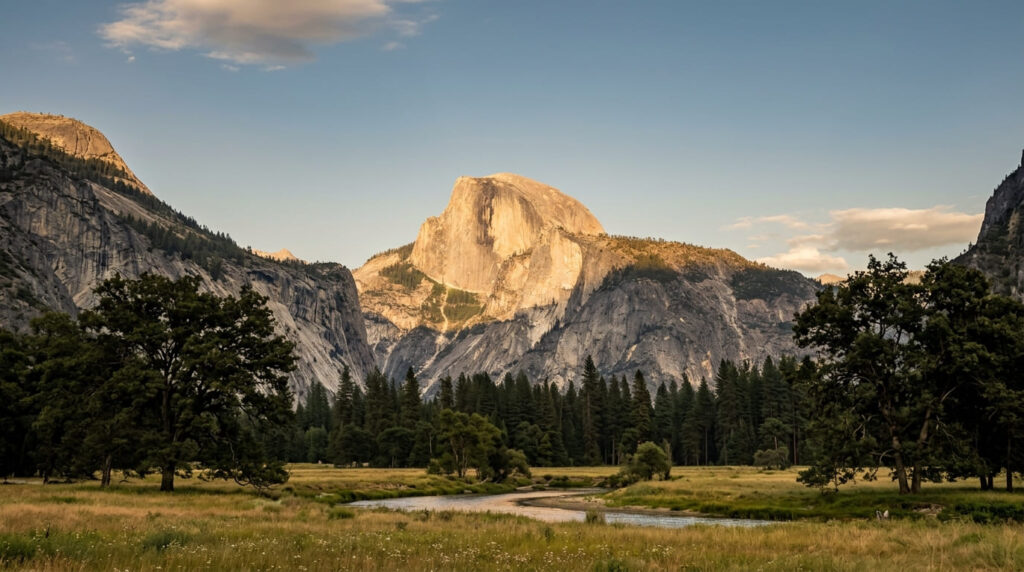
Every one of these shares three traits: strong name recognition well beyond the hiking community, a physical or visual superlative (Half Dome’s iconic granite face, Rainbow Falls’ waterfall, the JMT and PCT’s sheer length), and a permit system or notable access logistics that generates its own additional search volume on top of the trail’s baseline popularity.
That last point matters more than it might seem; people don’t just search “Half Dome hike,” they separately search permit lottery timing, cable season dates, and shuttle logistics, all of which compound the total demand around these specific names.
It’s a pattern we cover in more mechanical detail in our difficulty-calculation guide: the same trails that rate hardest on a pure elevation-and-terrain basis also tend to carry the heaviest permit and logistics search demand, and Half Dome and Whitney both sit at that intersection.
Most-Searched Non-Trail Hiking Terms
“All Trails Hiking App” and the Rise of App-Specific Search Intent
Found during research for our hiking apps comparison guide, “all trails hiking app” sits at exactly 50,000/mo, the same tier as Half Dome itself.
That’s a notable finding on its own: a meaningful share of total hiking-related search demand in California isn’t about a specific trail at all; it’s about the tool people use to find one.
If AllTrails’ own app name is pulling Half Dome-level search volume, trail-discovery behavior has shifted at least partly from “search for a specific place” to “search for the app, then browse from there.” Our head-to-head comparison of AllTrails, Gaia GPS, and Komoot goes deeper into what’s actually driving that shift.
Most-Searched Counties for Hiking Content
Which Counties Dominate Search Demand
Two clusters consistently outperformed comparable searches everywhere else in our county-by-county research: Los Angeles County (Malibu specifically, plus Griffith Park, both independently at 5,000/mo) and the South Lake Tahoe/Emerald Bay area of El Dorado County (South Lake Tahoe, Emerald Bay, and Lake Tahoe broadly, all three independently at 5,000/mo).
For comparison, the equivalent landmark-level search for most other counties in our research, Santa Cruz, Napa, Sonoma, Santa Barbara, Sacramento, sits at roughly a tenth of that, around 500/mo or lower. Our coastal guide from Malibu to Palos Verdes and our guide ot the best trails near Lake Tahoe cover these two specific clusters directly.
The data shows no clean regional split between Southern and Northern California. Demand clusters around specific iconic destinations far more than it splits along a regional line; the LA metro cluster and the Tahoe Basin cluster are comparable in scale to each other, just concentrated in very different parts of the state.

Which National Parks Get the Most Hiking-Specific Search Volume
Yosemite’s Outsized Share of National Park Search Interest
This is the single clearest pattern in the entire dataset. Adding up every Yosemite-related hiking search term in our research, “hiking trail yosemite,” “yosemite valley hiking trails,” and “upper yosemite falls hike” alone account for 150,000 of it.
Yosemite-specific hiking searches total roughly 177,500/mo across 13 distinct terms, before even counting Half Dome or the John Muir Trail separately, since neither of those terms contains the word “Yosemite” itself.
If you fold those two in, since both are physically inside Yosemite, the park’s true combined search footprint is well over 250,000/mo.
The next closest California national park, Sequoia, totals around 52,000/mo across its own terms, meaning Yosemite alone outweighs it by more than 3 to 1, and outweighs Joshua Tree (21,500), Kings Canyon (20,000), Lassen (20,000), Pinnacles (15,000), Death Valley (10,000), and Redwood (6,000) combined, several times over.
What’s notable isn’t just that Yosemite wins; it’s the margin. California has nine national parks, several of them spectacular and heavily visited in their own right, and none of the other eight combined come close to matching Yosemite’s search footprint alone.
That’s a different pattern than “one popular park among several popular parks”, it’s closer to one park operating in its own category entirely, with the rest of the state’s national park system clustered well below it.
What This Data Reveals About How Californians Actually Hike
Iconic, Permit-Gated Trails Drive Disproportionate Interest
The overall pattern across every section above tells a consistent story: a small number of iconic, often permit-restricted trails and destinations drive a wildly disproportionate share of total hiking search demand in California, while the vast majority of trails covered across this site’s 39 county guides individually receive far more modest, though still real and meaningful, search interest.
That’s not a knock on the hundreds of other trails covered across this project; it’s simply how search demand concentrates around fame, superlatives, and logistics complexity rather than distributing evenly across comparable hiking experiences.
The honest bottom line: if you’re chasing search traffic alone, Half Dome, the JMT, the PCT, and Yosemite broadly will always out-earn everything else on this site by an enormous margin.
The long tail of specific, well-researched county and trail content is where most actual hikers’ real, everyday questions live, even if it doesn’t show up as a 50,000/mo keyword.
Frequently asked questions about California hiking trail statistics
What is the most popular hiking trail in California?
Based on our own keyword research, Half Dome is the single highest-search-demand named trail in the state, tied at the top with Rainbow Falls, the John Muir Trail, the Pacific Crest Trail, and Upper Yosemite Falls; all five sit at 50,000 monthly searches, well above every other named trail we researched.
How many hiking trails are covered on this site?
At least 540 individually named trails, based on our 108 county-level Trail guides covering five trails each across 39 California counties. That’s a conservative floor; it doesn’t count the additional individual trails referenced throughout our Foundation-tier and destination-guide content, which would push the real total higher.
Is search volume the same as actual visitor numbers?
No, and this guide is explicitly about the former, not the latter. Search volume measures how often people look something up online, which correlates with real visitation but isn’t identical to it; permit-gated trails like Half Dome generate extra search volume purely from people researching lottery logistics, whether or not they ultimately go. For visitor counts, the National Park Service’s official Visitor Use Statistics portal and the California State Parks Statistical Report are the real, authoritative sources, not this guide.
Which county has the most hiking trails in California?
On this site specifically, there’s a 10-way tie: Los Angeles, San Diego, Riverside, San Bernardino, Marin, Santa Cruz, El Dorado, Tuolumne, Fresno, and Mono Counties each have exactly 5 Trail guides (25 trails). That’s by design; we intentionally gave our 10 highest-priority counties equal coverage rather than skewing toward one. For real-world trail mileage statewide, no single centralized source publishes an exact count, though California’s larger, public-land-heavy counties, San Bernardino (the largest county in the contiguous U.S. by area), Riverside, Fresno, Tulare, and Inyo, almost certainly have more trail mileage simply due to sheer size and National Forest coverage.
Do more people hike in Southern or Northern California?
Our search data doesn’t show a clean regional split either way. The Los Angeles metro area and the South Lake Tahoe/Emerald Bay area both guide similarly strong numbers despite being in opposite halves of the state; demand concentrates around specific famous destinations far more than it divides cleanly along a north-south line.
Where can you find official California trail visitation statistics?
For national parks, the NPS Visitor Use Statistics portal publishes recreation visit data back to 1979 for every park unit, updated monthly. For state parks, the California State Parks Statistical Report is published annually and covers attendance, acreage, and visitor use facilities across the entire state park system.