Runyon Canyon Hiking Guide: Trails, Trailhead Gates & Parking
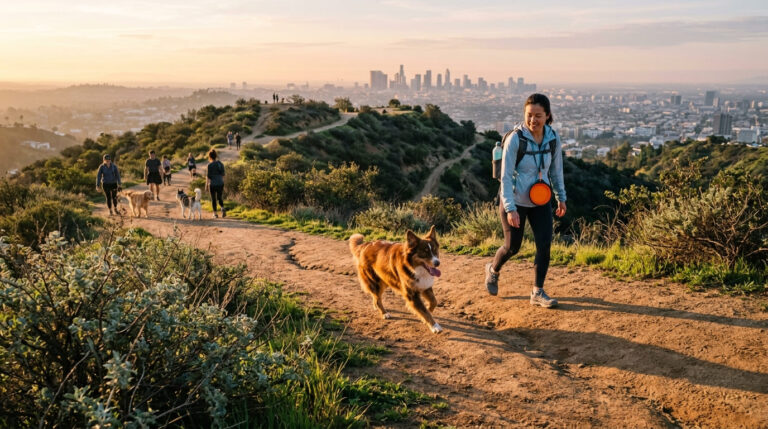
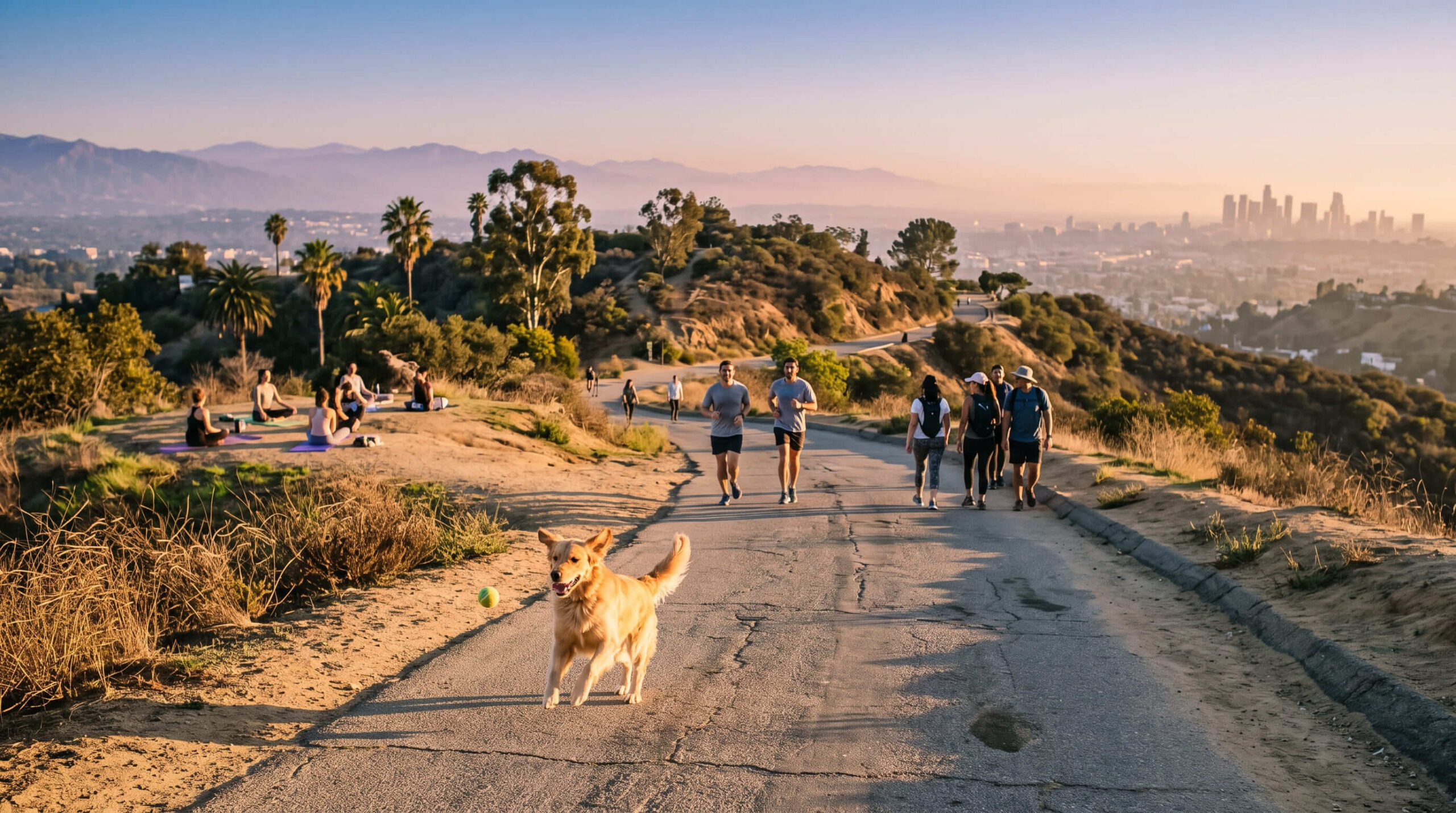
Fuller Avenue climbs out of Hollywood’s street grid, past bungalows and tightly parked cars, and then it stops at a gate. Beyond the gate, a paved road keeps climbing, and the city climbs with it: runners in headphones, a yoga class spread across a lawn, a golden retriever sprinting off-leash after a tennis ball it has no plan to return. This is Runyon Canyon, a 160-acre city park at the eastern end of the Santa Monica Mountains, and for most Angelenos it is the nearest thing to a mountain trail that doesn’t require a freeway.
Disclosure: Please note that some of the links below are affiliate links and at no additional cost to you, I may earn a commission. Know that I only recommend hiking gear I personally stand behind; when you use my affiliate links, it helps me run this blog and keep all of this content free of charge for readers (like you).
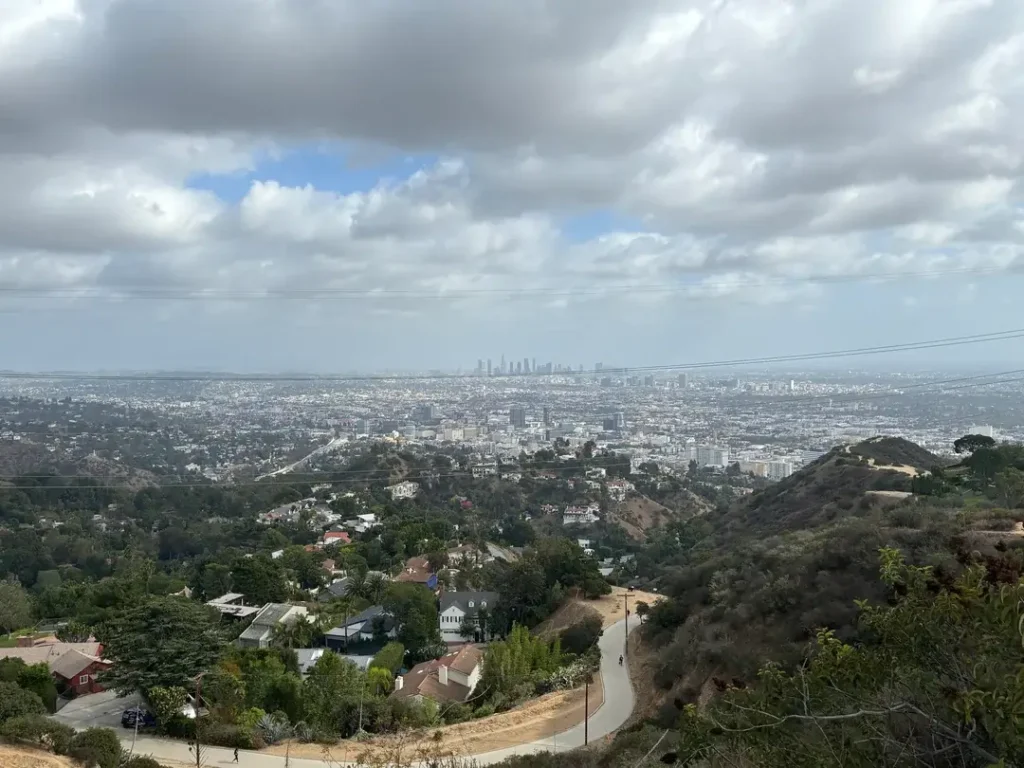
This guide walks the whole Runyon Canyon hike, from the Runyon Canyon trailhead at the Fuller Gate to the ridges that look across to the Hollywood Sign and downtown Los Angeles. You’ll find each Runyon Canyon trail option with distance and elevation change, a frank look at Runyon Canyon parking, the dog rules, the status of the fire-damaged West Trail, and the history of a canyon that once held a tenor’s mansion. It is one of the anchor hikes in our Los Angeles County hiking trails guide and one of five picks in our guide to the best hiking trails in Los Angeles.
Runyon Canyon at a Glance
| Detail | What to know |
|---|---|
| Location | Hollywood, Los Angeles; eastern end of the Santa Monica Mountains |
| Manager | City of Los Angeles Department of Recreation and Parks |
| Park size | About 160 acres |
| Hours | Sunrise to sunset, daily |
| Cost | Free; no permit needed |
| Hike lengths | 0.85 to 3.3 miles |
| Elevation change | Roughly 200 to 800 feet, depending on the loop |
| Difficulty | Easy on the main road; moderate with steep pitches on the ridge trails |
| Dogs | Off-leash in designated areas only |
| Restrooms | None listed by the city |
| Main trailhead | Fuller Gate, 2000 N. Fuller Ave., Los Angeles, CA 90046 |
Check the Runyon Canyon Trail Status First
Runyon Canyon is open, but one section needs a caveat. The January 2025 Sunset Fire burned through the park, and the city closed the West Trail, the steep western ridge, so the hillside could recover. The LA Parks Runyon Canyon page still lists the West Trail as closed and the rest of the park as open. Local news outlets reported in February 2026 that fencing had come down and hikers were back on the ridge, so the ground may not match the listing.
When the two disagree, follow the official listing. Closures exist to limit erosion on burned slopes and protect plants that are still recovering. Check the page the morning you go. The east side and the main road are open and cover most of what people come for. The city has also closed the park early around July 4th, so holiday visits deserve a second look.
Getting to the Runyon Canyon Trailhead
Runyon Canyon has several ways in, and your choice shapes the day.
Fuller Gate (south). The main Runyon Canyon trailhead sits at the top of North Fuller Avenue, about two blocks north of Hollywood Boulevard. Most loops begin here, and most of the crowd enters here. There is no parking lot, which is the root of nearly every complaint about the park.
Vista Gate (southwest). A short walk west of Fuller, this gate on North Vista Street opens onto the same lower canyon road. Nearby parking is tightly restricted, so it suits people arriving on foot or by rideshare.
Mulholland Gate (north). The north entrance sits in the 7300 block of Mulholland Drive, and the National Park Service’s site information for Runyon Canyon places it 2.6 miles east of Laurel Canyon Boulevard. Starting here puts you at the top of the park, with the shortest route to the high point and a small dirt lot nearby.
Runyon Canyon Parking: What Works
Parking is the hardest part of a visit, so plan it before you plan the hike.
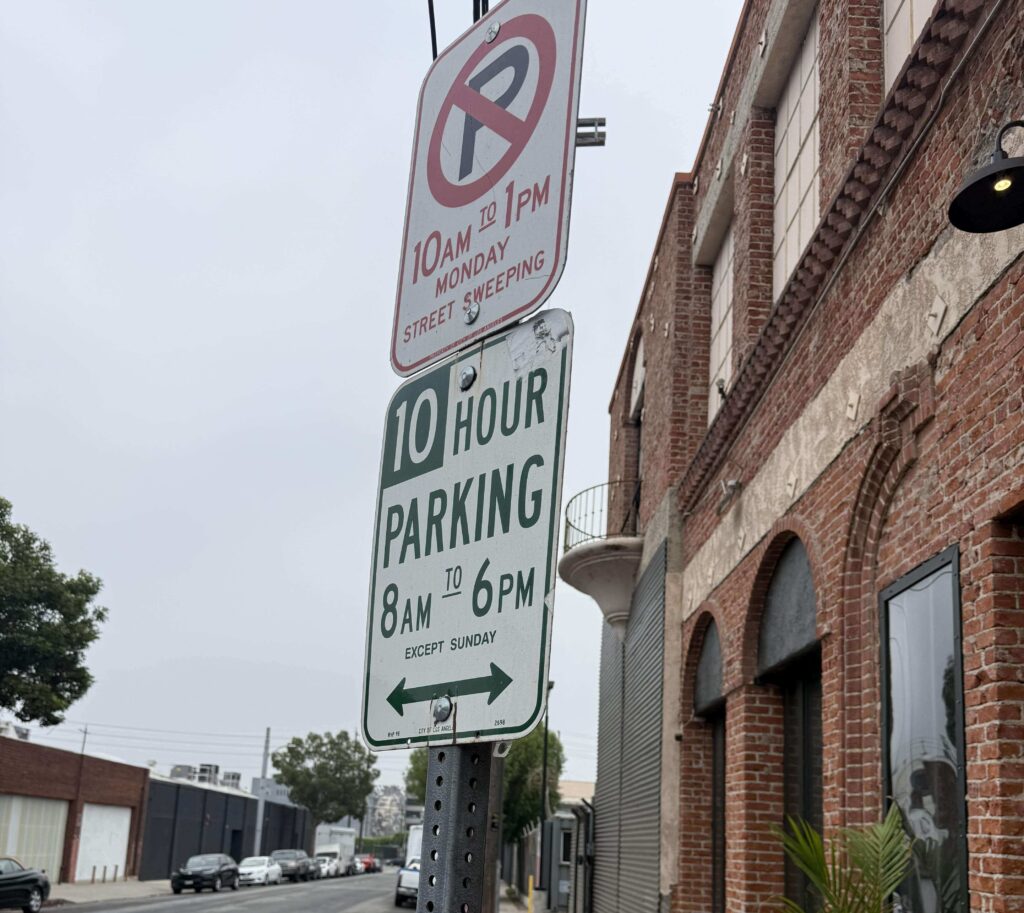
Street parking near Fuller. It’s free but heavily regulated. The city has added permit-only and time-limited zones on residential streets around the park, and many signs carry day-of-week and street-cleaning restrictions in smaller print. Read every line before you walk away. Weekday mornings are easiest, because spots open as neighbors leave for work. Weekend mornings fill quickly, and late afternoon gets crowded again when the after-work crowd arrives.
Park farther out and walk. Some hikers leave the car ten to fifteen minutes from the gate on unrestricted blocks and treat the walk as a warm-up. It beats circling for forty minutes.
The Mulholland lot. The dirt lot at the north entrance has about 25 spaces. It can be a better bet from the San Fernando Valley side, and it fills up too. Curbside parking on Mulholland has its own rules.
Skip the car. Friends of Runyon Canyon, the park’s volunteer group, points visitors toward rideshare, Metro, biking, or walking. If you’re staying in Hollywood, the Fuller Gate may be a short walk from your hotel.
Runyon Canyon Trail Options
Every Runyon Canyon trail shares the same skeleton. A wide road climbs the canyon floor, an east ridge trail climbs the side nearest the Hollywood Sign, a west ridge trail climbs the opposite wall, and a fire road links them near the top. Mix them, and you get four loops. Guides measure these routes a little differently, so expect a tenth or two of a mile either way.
| Loop | Distance | Elevation change | Character |
|---|---|---|---|
| Mulholland short loop | 0.85 miles | About 200 feet | Starts at the north gate; quickest route to the high point |
| East Ridge and fire road loop | 1.9 miles | About 500 feet | The first-timer favorite, with the best skyline views |
| West Ridge loop | 2.65 miles | About 700 feet | Adds the steep western ridge; check status first |
| Full loop to the high point | 3.3 miles | About 800 feet | Longest option; reaches the summit overlook |
The main road. Runyon Canyon Road, a fire road closed to cars, runs up the middle of the park toward Mulholland Drive. It’s the gentlest grade in the park and the choice for strollers, dogs, and visiting relatives.
The East Ridge Trail. Some maps call it the Star Trail. It leaves the main road at Inspiration Point and climbs with the help of wooden steps, gaining about 340 feet in a third of a mile before it levels out at Clouds Rest.
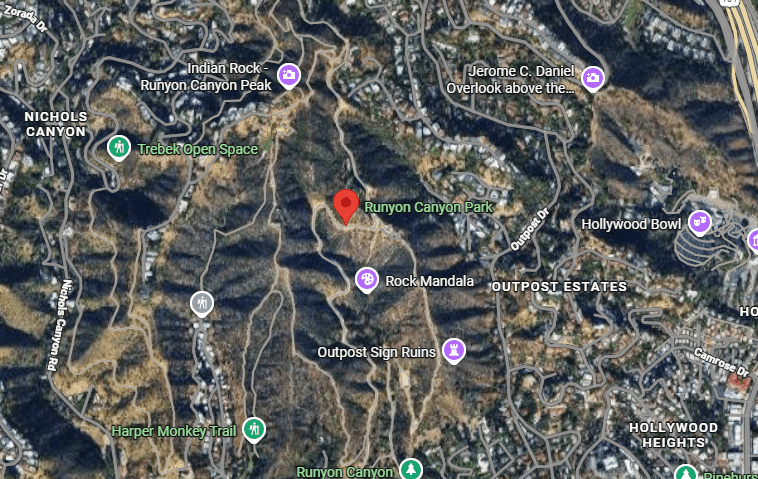
The West Ridge Trail. Maps also call it the West Trail, Western High Way Trail, or the Hero Trail. It is steeper, looser, and less maintained than the east side, and the descent drops about 600 feet in half a mile over loose dirt. It is also the section the city lists as closed, so confirm its status before choosing a loop that uses it.
Your Runyon Canyon Hike, Step by Step
The 1.9-mile loop is the version most visitors do, and it unfolds in a satisfying order.
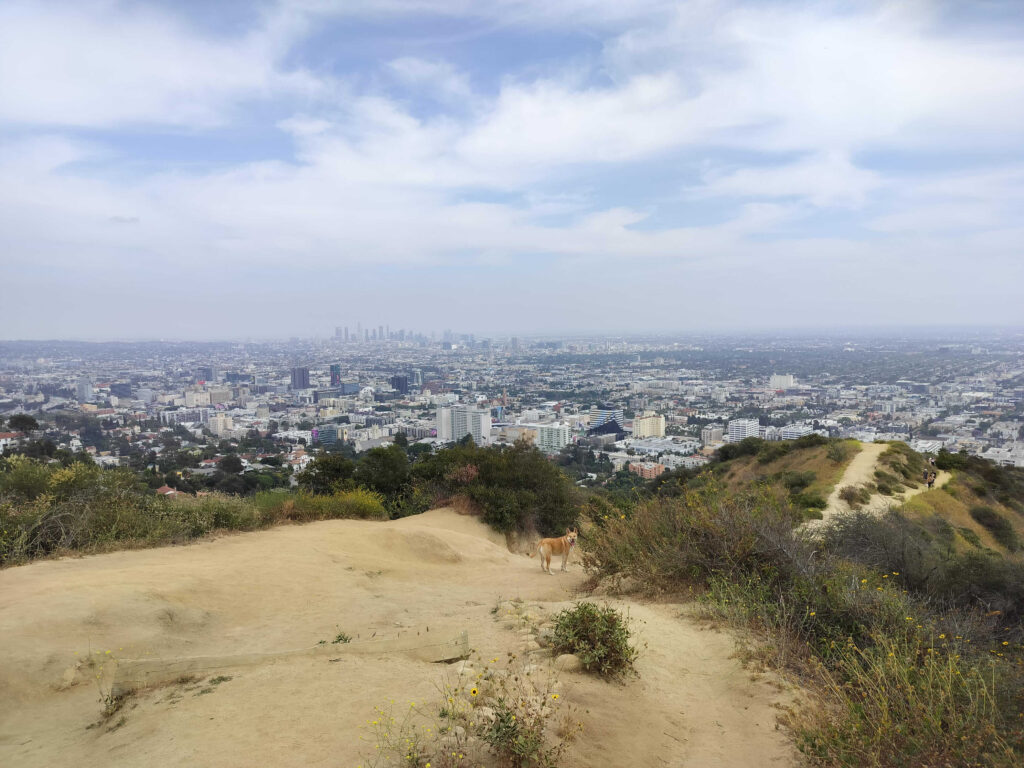
You pass through the Fuller Gate, and within minutes the lawn where yoga classes meet is on your left. The road narrows and climbs the lower canyon, where the signed off-leash areas begin and the dog count peaks. Around 0.45 miles in, the road bends sharply right and reaches Inspiration Point, a bench with a first wide look over Hollywood’s grid and, depending on the haze, downtown.
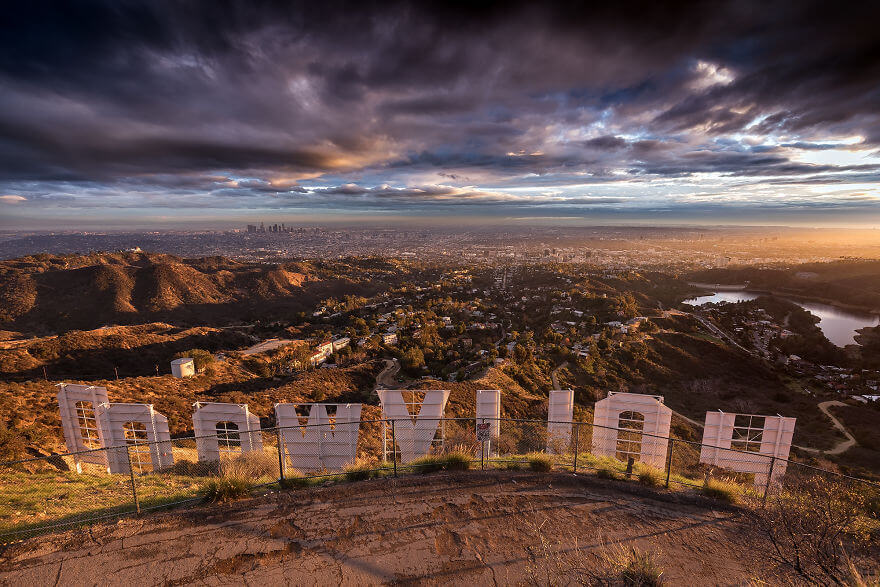
Most people sit here for a minute. Then the trail turns to a narrow track and heads straight up the ridge. The wooden steps are steep enough to make you stop and look behind you, which is how you notice the view widening with every landing. At about 0.8 miles, you reach Clouds Rest, a perch at roughly 1,040 feet, where the Hollywood Sign sits on Mount Lee beside Griffith Observatory and the downtown towers fill the horizon.
The ridge trail meets the fire road near the 0.95-mile mark. Turn left, and the road eases you down the far side of the canyon, past the Vista Gate and back to the main road. Turn right, and you commit to a longer day: the fire road continues toward Mulholland, where the full loop reaches the park’s high point, around 1,320 feet. On a clear day, the Pacific shows up to the west beyond Santa Monica.
Dogs at Runyon Canyon
Dogs are the park’s unofficial mascots. Runyon Canyon has designated off-leash areas, mostly in the lower canyon along the main road, and the commonly cited figure is that about 90 of the park’s 160 acres allow it. The city’s rule is that dogs may be off-leash in designated areas only and must be leashed everywhere else, so look for the signed gates where the zones begin.
Carry water and a bowl, since the lower road gets hot, and bring waste bags, because this park sees more foot and paw traffic than most in Los Angeles. Keep dogs close at dawn and dusk, when coyotes move through the canyon and sometimes take small animals. For general leash rules across the state, see our guide to hiking with dogs in California.
Best Time to Hike Runyon Canyon
Early on a weekday is the sweet spot. The light is soft, the air is cool, parking is manageable, and the trail has room to breathe. Weekends are the opposite: a crowd on the main road, a line on the steps, and a hunt for a parking space.
Heat matters more than most visitors expect. The slopes are chaparral with little shade, and the city’s posted advice is to carry water and stay hydrated. In summer, start at sunrise, and browse our list of California hiking trails that beat the heat if you want somewhere cooler. Our guide to weather hazards on California trails explains how heat and sudden weather shape a hike. The park closes at sunset, so the last warm light on the city is also your cue to head down.
What to Bring
Runyon Canyon doesn’t demand a gear list, but a few items help.
- Water. Fountains have been reported along the lower road, but don’t count on them.
- Shoes with grip. The ridge trails are sandy and loose in places.
- Sun protection. A hat and sunscreen matter on an exposed ridge.
- Waste bags, if you’re bringing a dog.
- A restroom plan. The city lists no restroom facilities in the park. Local news reported one planned for the Fuller entrance in early 2026, but until the city page says otherwise, treat it as unavailable.
Smoking is not allowed anywhere in the park, and the city asks hikers to stay on designated trails to protect the habitat. With this many people on narrow trails, a quick read of our hiking trail etiquette rules helps everyone, especially on the steep stretches where traffic runs both ways.
Wildlife and Plants
For a park with this much traffic, Runyon Canyon keeps a surprising amount of wildness. The plant list reads like a Southern California field guide: black sage, California sagebrush, toyon, laurel sumac, scrub oak and golden yarrow, among several hundred species. Hawks and owls work the sky, and deer, coyotes, lizards and snakes use the quieter slopes. Give snakes room and stay on the trail.
The Story Beneath Your Boots
The area was reputedly a seasonal camp for Tongva (Gabrielino) people, and early English speakers called it No Man’s Canyon. In 1867, “Greek George” Caralambo received the land for his service with the US Army Camel Corps, and in 1874 the bandit Tiburcio Vasquez was captured while hiding at his home.
Carman Runyon, a retired coal businessman, bought most of the land in 1919 for riding and hunting, and his name stuck. In 1930, the Irish tenor John McCormack bought the estate and built a mansion he called San Patrizio, after falling for the place while filming Song o’ My Heart in 1929. Huntington Hartford, the A&P grocery heir, bought it in 1942 and renamed it The Pines. He commissioned Frank Lloyd Wright and Wright’s son Lloyd Wright to draft plans for a cottage hotel and a ridge-top resort. Neighbors objected, and the big plans stalled. Lloyd Wright did build a pool pavilion at Inspiration Point, which burned in 1972 and left only stone foundations.
In the 1960s, Jules Berman, the Kahlúa importer, bought the canyon, demolished the mansion, and planned 157 luxury homes. Activists stopped the project in 1978. The City of Los Angeles bought the land for a park in 1984, and in 2007 the Trust for Public Land bought another 14.9 acres to keep development off the canyon’s edge. Today two Metro subway tunnels run deep beneath the park, invisible from the trail.
More Hikes After Runyon Canyon
- Fewer people. Browse our guide to lesser-known hiking trails in Los Angeles County.
- Salt air instead of skyline. Our guide to coastal hiking trails from Malibu to Palos Verdes covers the ocean side.
- More elevation. Runyon tops out around 1,320 feet. For high-country hiking, head to the San Gabriel Mountains.
- More dog-friendly hikes. See our list of dog-friendly hiking trails across California.
- First time in California? Our guide to California hikes for first-time visitors puts Runyon in context with the rest of the state.
The Honest Bottom Line
Runyon Canyon is not a quiet wilderness, and nobody should pretend otherwise. It’s crowded, parking is a chore, and the trail is shared with a lot of dogs. But it delivers something few city hikes can: a steady climb, a wide view of the Hollywood Hills and the city, and a history that runs from Tongva hunters to Irish tenors, all within a few blocks of Hollywood Boulevard. Go early on a weekday, carry water, read every parking sign twice, and confirm the West Trail status on the LA Parks page. The rest takes care of itself.
Runyon Canyon FAQ
Is Runyon Canyon open right now?
The park is open from sunrise to sunset daily. The West Trail has been listed as closed following the January 2025 Sunset Fire, so confirm status on the LA Parks page before you go.
Is the Runyon Canyon hike hard?
The main road is a steady climb most people handle comfortably. The east ridge steps and the west ridge are steeper and rougher, so treat those as moderate.
How long does the Runyon Canyon hike take?
Most hikers finish in about an hour and a half. The short Mulholland loop takes closer to fifteen to thirty minutes, and the 3.3-mile loop can take two hours with stops.
Is there parking at Runyon Canyon?
There’s no lot at the Fuller Gate, only residential street parking with permit and time restrictions. A small dirt lot at the Mulholland entrance holds roughly 25 cars. Arrive early on a weekday, or use rideshare.
Are dogs allowed off-leash?
Yes, in designated off-leash areas only. Everywhere else, dogs need a leash.
Does it cost anything?
No. Entry is free, and no permit is required.
Can you see the Hollywood Sign from Runyon Canyon?
Yes. It’s visible to the east from the east ridge, Clouds Rest, and the high point, along with Griffith Observatory.